

Objective
The objective of the research project is the development of a technology for manufacturing novel semi-finished products based on actuator-integrated textile preforms and corresponding control mechanisms, using the example of a shape-variable and load-adaptive adjustable guide vane for axial-flow turbomachines.
Guide vanes are characterized by their aerodynamic shape and are used for targeted flow guidance at the outlet of fans. The load-adapted design and arrangement of these vanes within the turbomachine have a decisive influence on both energy efficiency and noise emissions. The application of the new materials and control mechanisms will enable entirely new approaches to increasing energy efficiency and reducing acoustic emissions.
Through the three-dimensional integration of smart materials (switchable shape memory alloys (SMAs), e.g. based on NiTi) into a textile reinforcement structure, or their use as an independent textile reinforcement structure, combined with the integration of the required control electronics, these semi-finished products will become flexibly controllable in terms of their shape. This will allow them to be adapted dynamically and rapidly to changing functional requirements in technical processes.
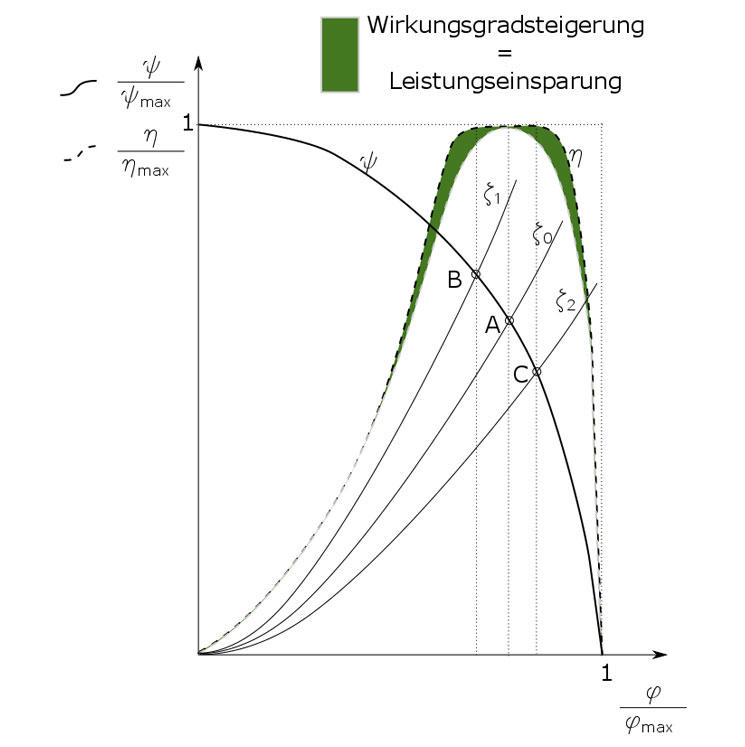
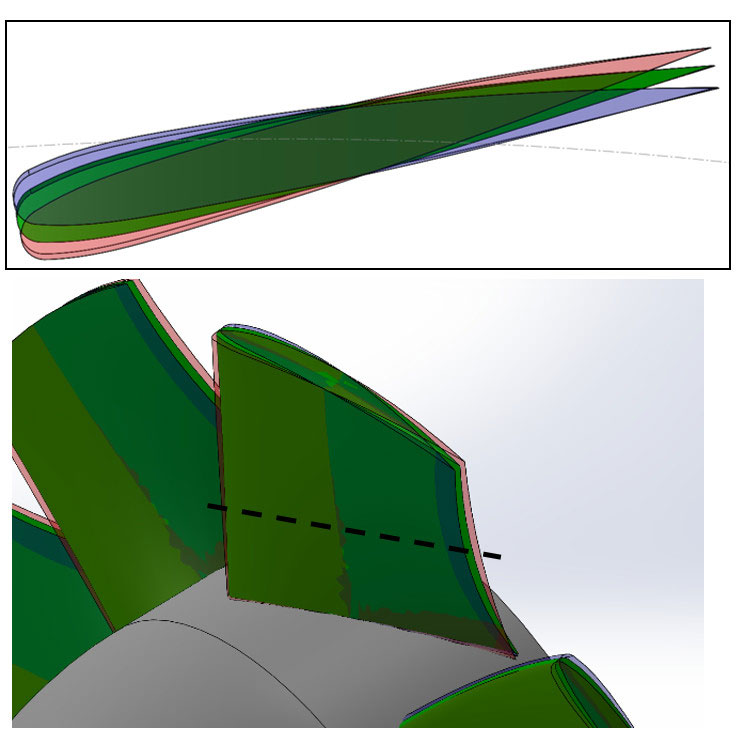
Scientific and/or Technical Objectives of the Project
Currently, approaches for the textile integration of shape memory alloys (SMAs) exist only at laboratory scale or as non-practical functional prototypes. The field of electronic actuation and control of SMAs as a basis for the flow- and load-adaptive adjustment of the shape and orientation of actuator-based semi-finished products remains largely unresolved.
To develop actuator-based, hybrid fiber-reinforced composites, the following scientific and technical objectives must therefore be achieved:
- Investigation and evaluation of different textile fabric-forming technologies for the design and manufacturing of textile SMA-integrated preforms
- Development of textile-processable shape memory alloys (SMAs) in the form of wires, strands, or rovings
- Development and design of innovative control concepts and actuator control mechanisms based on SMAs
- Integration of smart materials as actuators into textile manufacturing processes
- Evaluation of actuator-based, functionalized textile preforms as structural carrier elements
- Development of process technologies for laminate manufacturing to enable the continuous production of hybrid prepregs
- Comprehensive material and semi-finished product characterization using mechanical testing methods (peel and shear tests, static and dynamic tests, etc.) and optical measurement techniques (microsection analysis, scanning electron microscopy (SEM), micro-computed tomography (µCT), etc.)
- Investigation of the forming behavior of partially consolidated prepregs as a basis for developing design principles and tool concepts
- Development of composite manufacturing technologies with consideration of scalability and industrial implementation
- Demonstration of component manufacturability through the production and evaluation of demonstrator components
- Development of a novel value chain enabling cross-sectoral application opportunities
