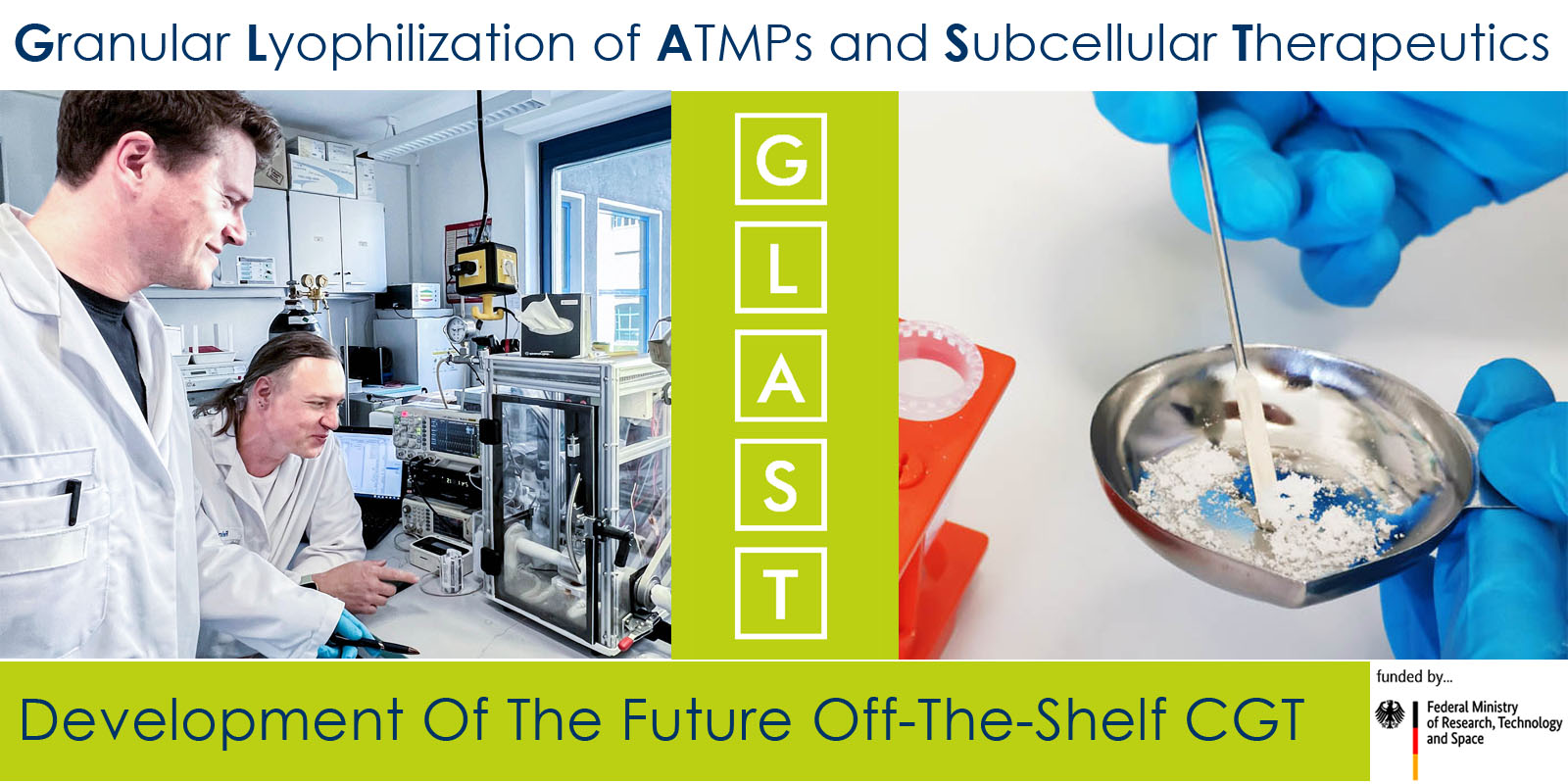
Cell and gene therapies (CGT) are revolutionizing medicine, offering the prospect of a cure for advanced tumors and rare genetic diseases. However, the high cost of these therapies is increasingly straining healthcare systems. By producing freeze-dried, shelf-stable product formulations, GLAST aims to pave the way for affordable CGT.
Vitrification and freeze-drying of biopharmaceutical products containing living cells and biologically active cell organelles into free-flowing, portionable granules that can be stored (ideally at room temperature) for at least three months and easily reconstituted with lukewarm buffer into a ready-to-use product.
Procedure
Nanodroplet vitrification is the first step in the function-preserving freeze-drying of cell and gene therapy (CGT) products containing therapeutic cellular components or viable cells. Using high-performance piezo technology, the product suspension is dispersed into monodisperse nanodroplets with a product-specific volume ranging from 0.25 nl to 5 nl. Depending on the droplet size, between 3,000 and 12,000 droplets are generated per second.
Upon contact with a cryogenic medium, the droplets are instantly vitrified at cooling rates of up to 4.5 million degrees Celsius per minute, transforming the product into cryogenic, pourable, and storable microgranules containing biologically active cellular components or viable cells. The vitrified product can easily be reconstituted with lukewarm buffer to create a ready-to-administer product.
This rapid cooling process largely or entirely eliminates the need for membrane-damaging cryoprotective additives such as DMSO. In a second process step, the vitrified product granules are freeze-dried while retaining their biopharmaceutical activity. The extremely large surface area of the microgranules enables rapid and gentle lyophilization. By avoiding low-melting cryoprotective additives, the result is a product that can be stored at ambient temperature – ideally with complete preservation of the functionality of the therapeutic cells it contains.
Findings
In a previous project, we were able to successfully demonstrate the vitrification of viable human cells using extremely low DMSO concentrations of 5% to 10%. Through incremental process optimization and the integration of innovative cell-biological cryoprotection strategies, we aim to achieve cell vitrification entirely without DMSO or other permeable cryoprotective additives by 2026, thereby establishing a crucial prerequisite for viability-preserving freeze-drying.
This will be followed by the freeze-drying of a medicinal product containing active mitochondria. Subsequently, the results are to be applied to cells by 2028.