Motivation and Objectives
Industrial animal farming is a source of immense animal suffering. In addition, it consumes almost 80% of all agriculturally usable land and is responsible for around 15% of global greenhouse gas emissions. To help avert the imminent collapse of global ecosystems, a complete transition of meat production to sustainable technologies is required. An ethical and resource-efficient alternative to conventional meat production is the manufacture of in vitro cultivated meat products from animal cells.
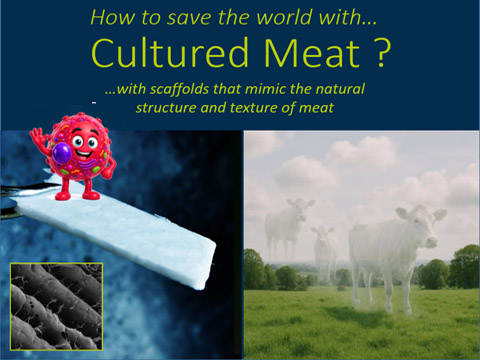
However, producing the natural fibrous texture of a real steak requires a complex and costly cultivation process. This process takes place in two stages: During primary cultivation, large quantities of animal cells are grown cost-effectively in large-scale bioreactors. During maturation cultivation, these cells are further cultivated under specific growth conditions in a sponge-like matrix structure made of proteins. This so-called scaffold provides the cells with a tissue-like support structure in which they can gradually mature into muscle fibers. This process is extremely time- and resource-intensive, which means that cultivated cutlets and steaks are currently up to twenty times more expensive than meat from animals. With the MADAM project, we aim to make cultured meat affordable for everyone.
To achieve this, we use a patented freeze-drying process developed at ILK Dresden called Model-based Ice Templating, or MbIT, which can be used to produce porous, three-dimensional scaffolds for cell culture from collagen or other proteins. The key feature of our process is that the pore shape, pore size, and mechanical strength of the resulting matrix structure can be adapted almost freely in order to provide optimal growth conditions for different cell types. In the MADAM R&D project, this process will be used to produce scaffolds with an elongated, fiber-like pore structure resembling naturally grown meat tissue. By adjusting the structure and protein content, the scaffold itself is intended to already provide a texture and bite firmness comparable to that of a steak. The animal cells are then only required for flavor, eliminating the need for complex maturation cultivation. This should enable the production costs of cultured meat to be reduced by more than half.
Aktueller Projektstand und Ausblick
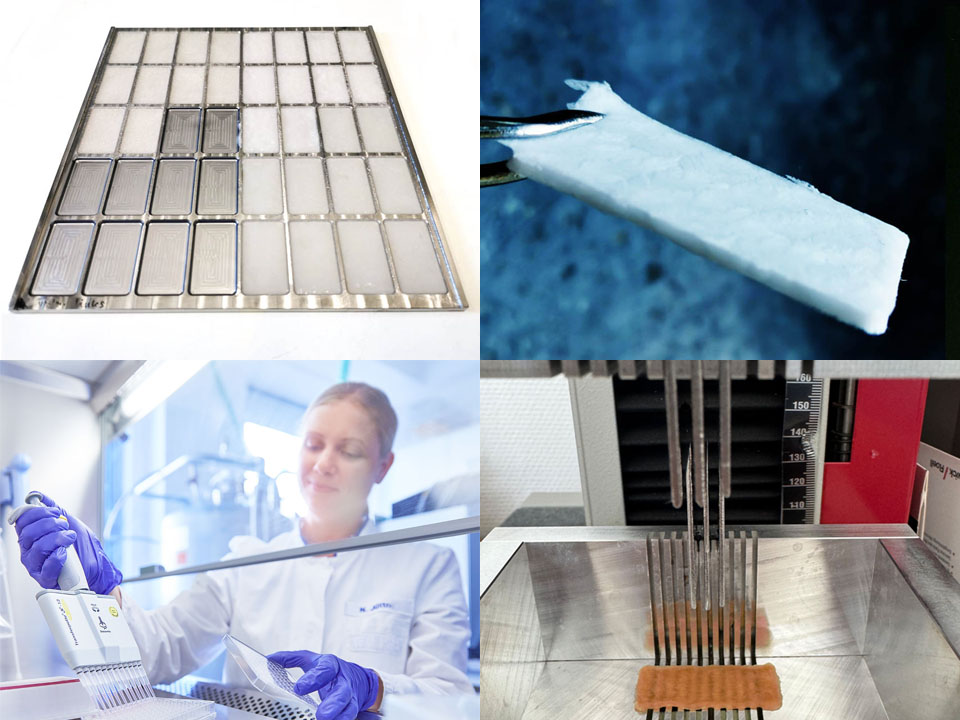
Using the MbIT process, porous support structures for the cultivation of animal cells into an artificial meat product were produced from collagen, an animal structural protein. For this purpose, various collagen suspensions were frozen in specially developed freezing molds on the shelf of a freeze dryer and subsequently freeze-dried. With a suitable freezing mold and well-controlled temperature management, ice growth can be directed in such a way that either a short, honeycomb-like pore structure or elongated, lamellar pore spaces are formed. This makes it possible to generate different material structures that imitate meat muscle cut both longitudinally and transversely.
The strength of the scaffolds was varied by adjusting the protein content and the resulting pore size, and was further increased by thermal post-treatment to crosslink the protein molecules. The bite behavior and mechanical strength of the resulting support materials were then determined using a Kramer shear cell and compared with a database of meat products. Depending on the protein content, the bite firmness of the hydrated scaffolds corresponded to that of chicken or pork. In the further course of the project, the scaffolds were seeded with muscle cells in order to produce meat equivalents. These will now be gradually optimized to precisely adapt their texture and firmness to the values of various types of meat.
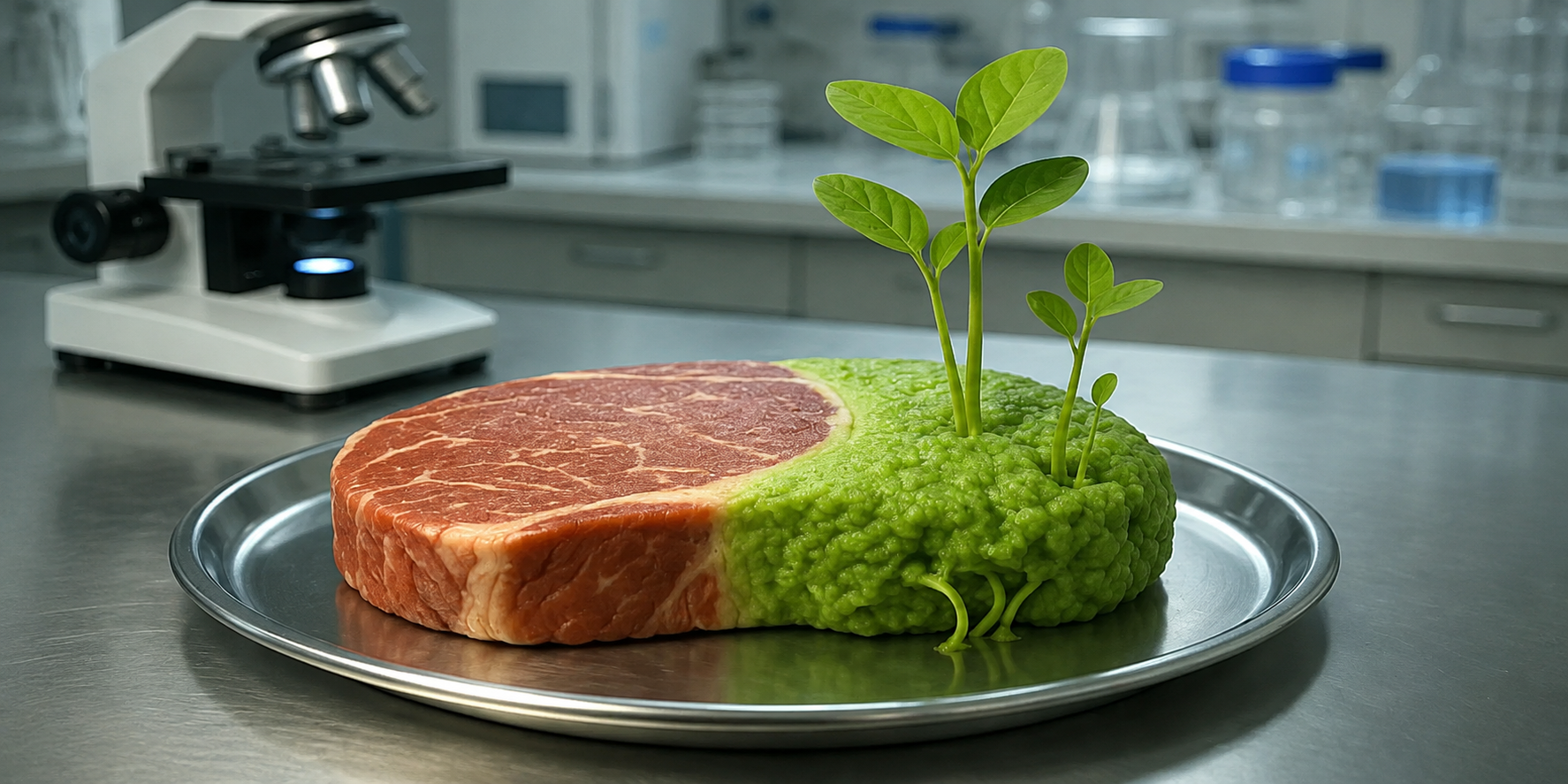
In parallel with the optimization of the collagen scaffolds, manufacturing trials were also carried out using plant-based proteins such as soy and lupin. By stabilizing the protein suspensions with auxiliary substances and using modern processing techniques, it was possible to produce appealing soy-based matrix materials. These plant-based scaffolds are pleasant to the touch, stable, flexible, and resistant to degradation. Unfortunately, they do not yet achieve the required mechanical strength.
Using structure-stabilizing processes, such as heat-induced linking of plant protein molecules into fiber-like structures through amyloid fibrillogenesis, as well as the production of composites from plant proteins and functionalized cellulose, the strength of the vegan matrix structures is being further increased in order to achieve the bite firmness and mouthfeel of a real steak. Only when the animal collagen in the cultivation matrix can be completely replaced by alternative proteins will our mission be fulfilled: ethical, entirely animal-free meat production at competitive costs.