“If vitrified cell products are to become more widely available in the future, thawing must be controlled just as precisely as freezing. Our project combines cryogenic engineering, biotechnology, and new methods for targeted warming to make this next technological step possible.”
Dr.rer.nat.
Andreas
Kade
Areas of application
ATMPs, cell therapies, biobanking, cryopreservation of biological samples, tissue and organ donation, as well as cryogenic systems, optics, and thermal switches.
Objective
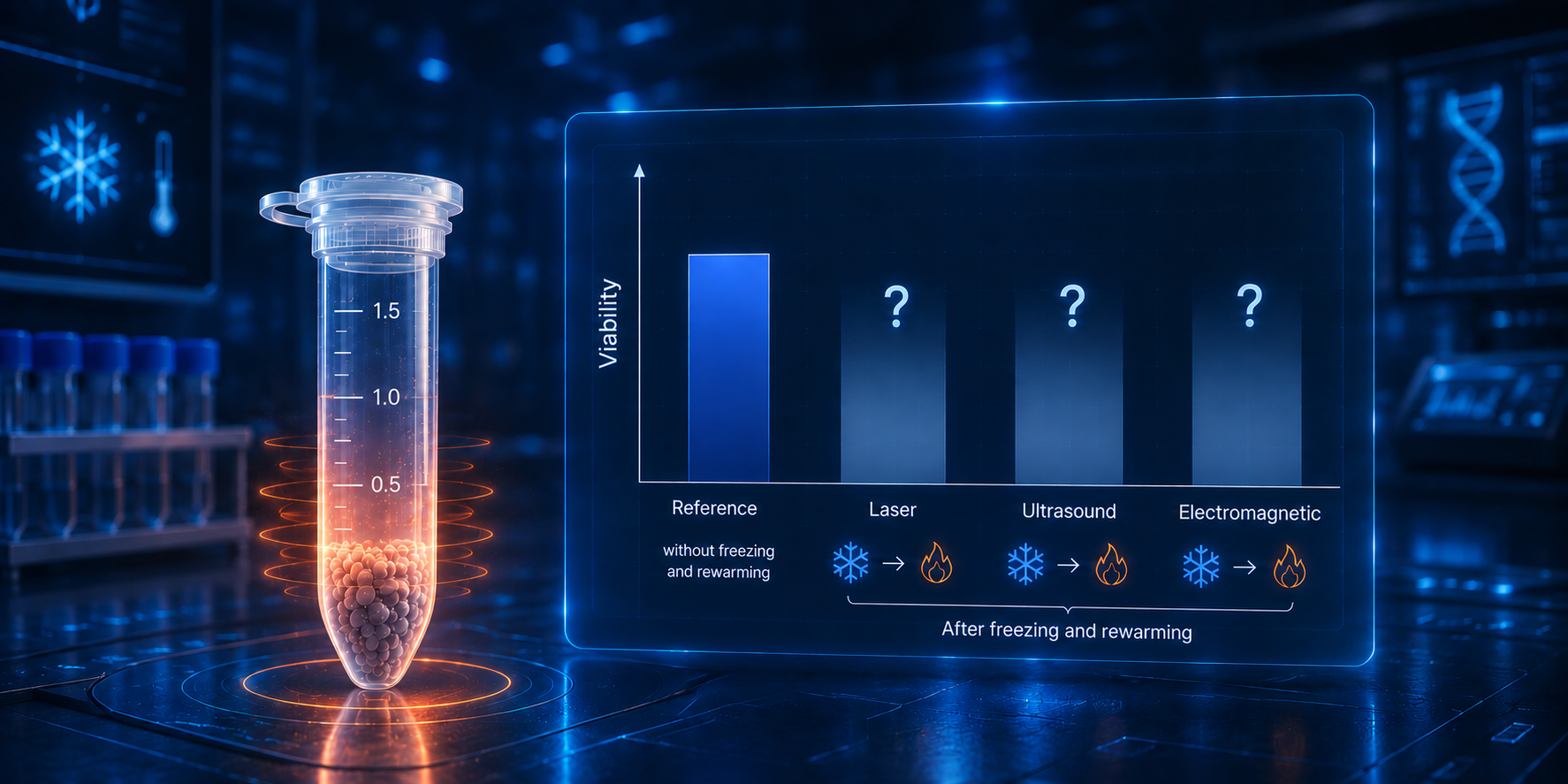
The project is developing an ultrafast, gentle thawing process for vitrified biological microgranules. By means of targeted energy input using lasers, ultrasound, or electromagnetic fields, ice crystal formation and cell damage are to be avoided — for applications in cell therapy, biobanking, and cryobiology.
Procedure
The project will first focus on gaining a deeper understanding of the physical principles of ultrafast thawing and translating them into technical solution concepts. To this end, suitable energy sources, particle materials, and process conditions will be investigated. Of particular interest is the question of how energy can be introduced into a deeply frozen particle system in such a way that all sample components thaw quickly enough without individual areas overheating or being damaged.On this basis, test rigs for different thawing principles will be developed and compared. Laser-based methods enable precisely controllable energy input, but place high demands on optics, wavelength selection, and process control. Ultrasound offers further possibilities, but requires suitable coupling concepts for cryogenic samples. Electromagnetic alternating fields could enable very rapid volumetric energy input, particularly in combination with absorbing nano- or microparticles. In parallel, simulations, preparative experiments, and measurement methods will be developed in order to better evaluate thawing rates, temperature distributions, and biological effects. Preliminary tests without cells will be used to define suitable process windows and reduce risks. Subsequently, selected configurations will be tested with biological samples.
Findings
The results are intended to form the basis for further developments and open up new applications in cryopreservation. In addition, the knowledge gained may also be relevant for technical cryogenic systems, such as fast thermal switches, cryogenic actuators, or high-precision optical systems. The project is therefore not only concerned with developing a new thawing process, but also represents a first step toward a broader technological platform for controlled energy input at low temperatures.