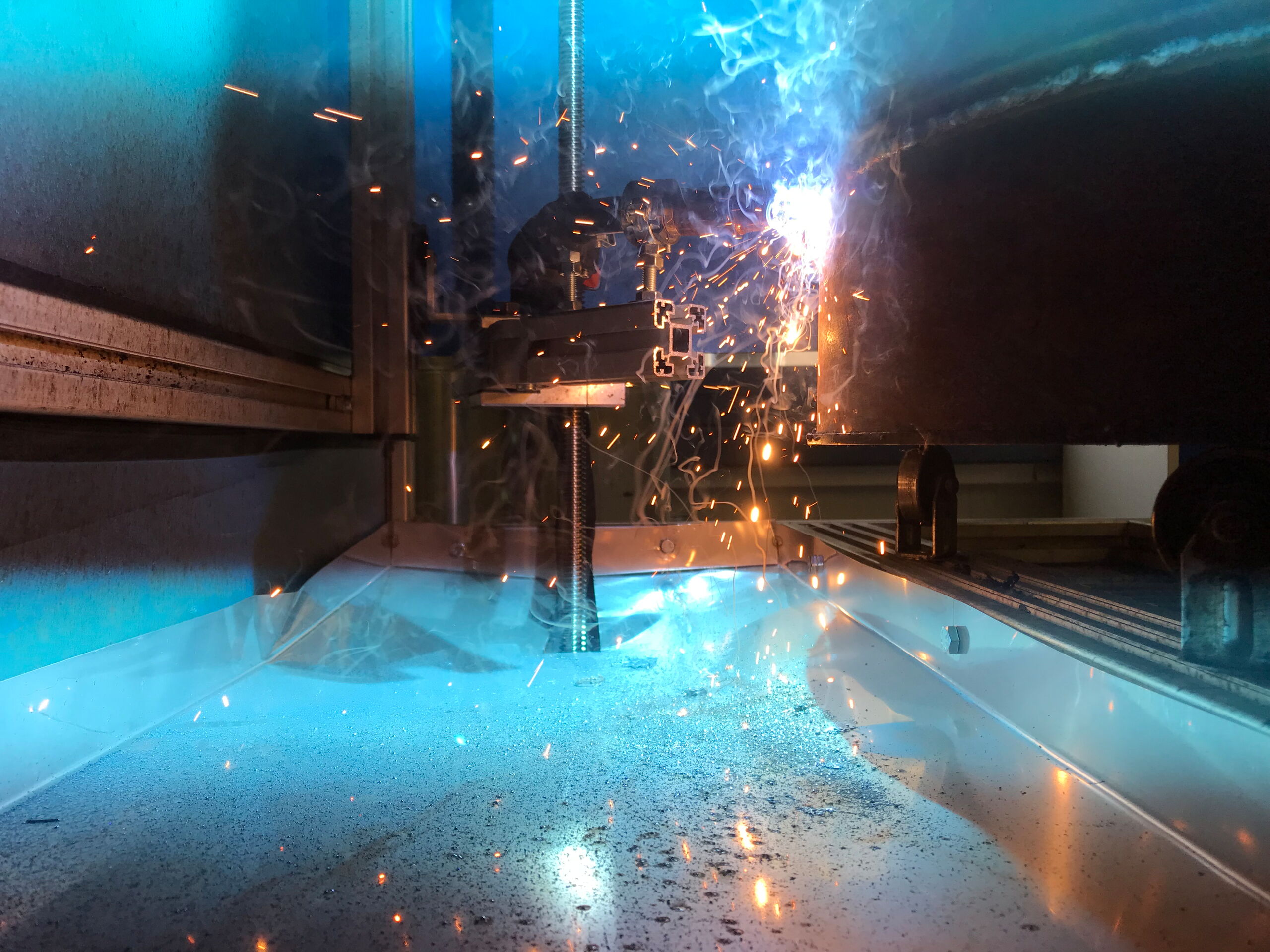
The European Commission is currently considering whether a flat-rate limit value for welding fumes should be included in Annex I of the Carcinogens, Mutagens, and Reproductive Toxins Directive (CMRD) 2004/37/EC—the CMRD list. This would have dramatic consequences, not least for the international competitiveness of the European welding industry.
Dipl.-Ing.
Ralf
Heidenreich
Areas of application
According to the Federal Statistical Office, approximately 1.6 million people are employed in metalworking companies. In the metal and mechanical engineering industries, welding is used today to manufacture assemblies for steel structures, (rail) vehicles, railway bridges, ships, containers, and pipelines, as well as products in the defense technology sector.
Objective
Welding fumes are classified as toxic and/or carcinogenic based on their potential dust constituents. To save energy, the filtered exhaust air should ideally be recirculated back into the production area. In accordance with legal regulations, for substances with occupational exposure limits (OELs, e.g., manganese), evidence must be provided for the recirculation of clean air to demonstrate that the clean air concentration is only 1/5 of the OEL (e.g., manganese: 4 µg/m³ (A)). For particulate carcinogens (nickel), the clean air concentration must not exceed 1/10 of the assessment value. Since no verification method currently exists, this proof does not need to be provided. Heavy metals are present in a form that can be filtered out during thermal aerosol generation (steel mills, foundries, welding, and cutting). Today, the particulate fraction is usually captured by high-performance membrane-coated filters. The filterable fraction is currently ignored. Due to the pending EU ban on PFA, all per- and polyfluorinated alkyl substances would have to be phased out of the market within transition periods ranging from 18 months to 12 years. The goal of the research project is therefore to develop a filter unit capable of capturing both particulate and filterable components of welding fumes, one that does not require membrane-coated materials and also meets the requirements for clean air recirculation at 1/10 of the assessment values for carcinogenic hazardous substances. To capture the particulate fraction, a filter element is being developed that features a surface structured with ultrafine fibers and can be easily regenerated.
Procedure
All welding fumes are to be extracted using a cost-effective and compact filtration system. Large quantities of highly dispersed welding fumes must be removed. This is only possible with high local air change rates (> 50/h) and flow velocities of 0.4 m/s directly at the source. Depending on the material being processed and the resulting particle size, the welding fumes generated can be explosive and flammable. This must be taken into account during the filtration process. The technical challenge lies in achieving stable operation at high flow rates. Additionally, the main filter element must be PTFE-free. To filter the large quantities of fine dust and fumes, the separator to be developed will include the following functions/elements:
• Agglomeration stage, • Surface coating of the filter medium.
The welding fume test rig at ILK Dresden was modified so that different exposure levels for the test material (Figure 1) can be achieved by varying the drum speed, feed rate, and type of filler material. The industrial testing phase was launched ahead of schedule (Figure 2) to evaluate various filter designs under real-world conditions. This issue remains urgent, as workplace measurements have shown that occupational exposure limits are being exceeded. Without the most comprehensive capture possible, welding fume extraction is too energy-intensive because the air volume triples with distance. Therefore, a new concept for welding fume capture was designed and implemented. The collection system also serves to capture sparks and perform pre-separation through an integrated, optional vortex element.