

Software Development
The algorithms developed by ILK Dresden on the basis of current standards and the state of the art are implemented in user-oriented software by SOLAR-COMPUTER. Particular emphasis is placed on ease of use and on interfaces that enable seamless workflows with the other applications included in the company’s comprehensive building-services design package, covering heating, air conditioning, ventilation, sanitary engineering, energy performance certificates in accordance with EnEV 2014, and economic feasibility calculations.
The joint development activities focus on algorithms for modelling the thermal behaviour of buildings. These are implemented in software for cooling-load calculations and dynamic annual thermal simulations in accordance with VDI 2078, as well as for calculating the annual energy demand for heating and cooling at hourly intervals in accordance with VDI 2067-10.
The software can also be used to verify summer thermal protection by calculation in accordance with DIN 4108-2 and to perform optimisation studies using individually defined boundary conditions.
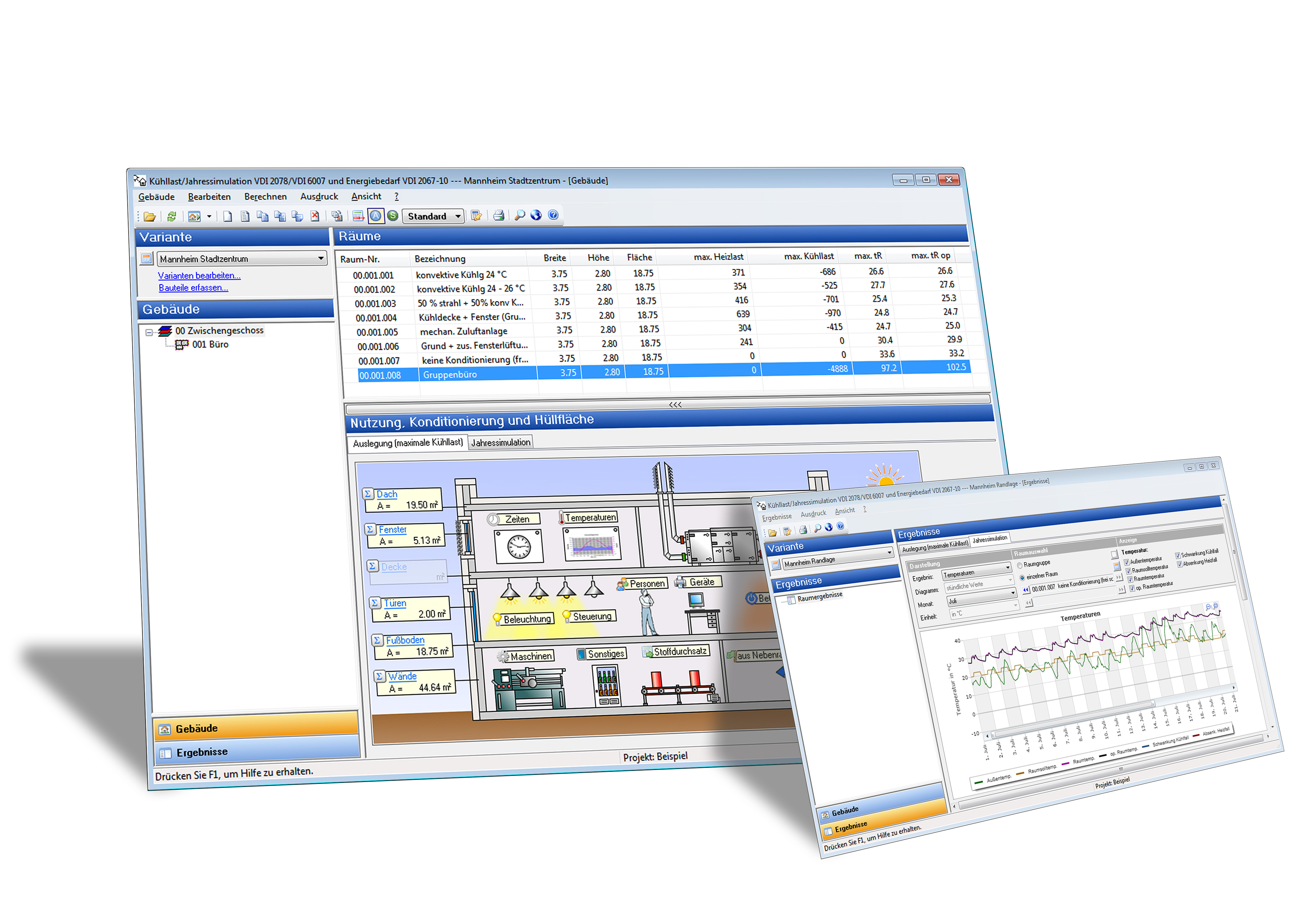
Cooling Load Calculation According to VDI 2078:2015-06
The software for calculating cooling loads and indoor air temperatures in accordance with VDI 2078 can be used both for verification during the design process and for optimising the building and its technical systems.
The cooling load and indoor air temperature under design conditions are calculated using the detailed calculation method. This method is based on the computational core described in VDI 6007-1 and incorporates a modern approach for determining cooling loads and calculating both indoor air temperature and operative temperature, i.e. the perceived temperature. The effects of transparent building components and solar radiation are taken into account in accordance with VDI 6007 Part 2 and Part 3, respectively.
The programs for calculating cooling loads and room temperatures as part of dynamic thermal building simulation use data from Test Reference Years (TRY). Fast, straightforward tabular data editing, supported by dedicated tools, enables centralised data modifications and efficient variant analyses.
The calculations take into account indoor air temperature, component cooling, internal and external shading, time profiles for loads, temperature setpoints, different operating modes, system characteristics, and the effects of control strategies and operating conditions. Extended calculations can also be performed while considering limited system capacities or the free-floating indoor air temperature during interruptions in system operation.
Comparison with VDI 2078:1996
The revision of VDI 2078 has been completed, and the final version has been available since June 2015. The main changes introduced in the revised VDI 2078 include:
- Direct consideration of the wall construction, eliminating the problematic classification into thermal-mass categories
- No further need to denormalise the thermal response of reference rooms
- Definition of a Cooling Design Period (CDP), consisting of:a 14-day preliminary calculation period with overcast and/or cloudy days,
a four-day initialisation period with sunny days and progressively increasing outdoor temperatures, and
a subsequent Cooling Design Day (CDD) with the maximum outdoor temperature, taking standardised usage conditions into account - Improved representation of solar radiation, including shading, horizon elevation, the orientation and inclination of irradiated surfaces, and solar-protection devices
Integration of thermally active system components - Definition of an allowable indoor-temperature fluctuation range
- Consideration of window ventilation as buoyancy-driven ventilation
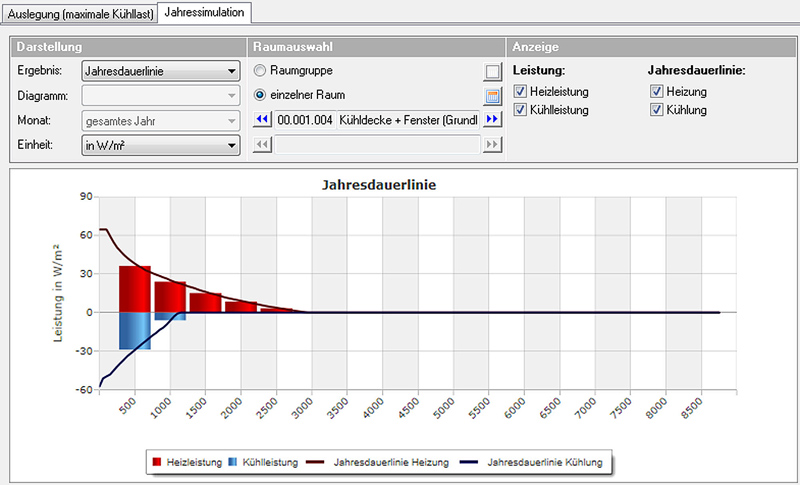
Energy Demand in Accordance with VDI 2067 Part 10
Using dynamic annual thermal and energy simulation under the conditions specified in VDI 2067 Part 10, the energy demand for heating, cooling, humidification and dehumidification can be calculated over the course of a year on the basis of actual hourly weather data.
The software requires an hourly climate dataset covering the period from 1 January to 31 December of a given year. These data can be imported as master data. The program supports climate datasets provided by the German Meteorological Service (Deutscher Wetterdienst, DWD), particularly Test Reference Years (TRY). DWD Test Reference Years are available in the 2004 and 2011 editions, as well as in a projected dataset for the year 2035. Location-specific DWD Test Reference Years for 2018 and 2045 can also be imported, together with Test Reference Year datasets generated using METEONORM.
Extended calculations can additionally account for limited system capacities and supply air with a variable temperature. The software can also calculate the free-floating indoor air temperature.
