
Areas of application
The test rigs developed at ILK Dresden are designed for the development, characterization and performance evaluation of fans under reproducible test conditions.
Objective
Airflow test rigs enable precise measurement of a fan's airflow, pressure, efficiency, and power consumption under controlled conditions. This allows objective performance evaluation, optimization, and validation according to international standards, ensuring high measurement accuracy and reproducible test results.
Description
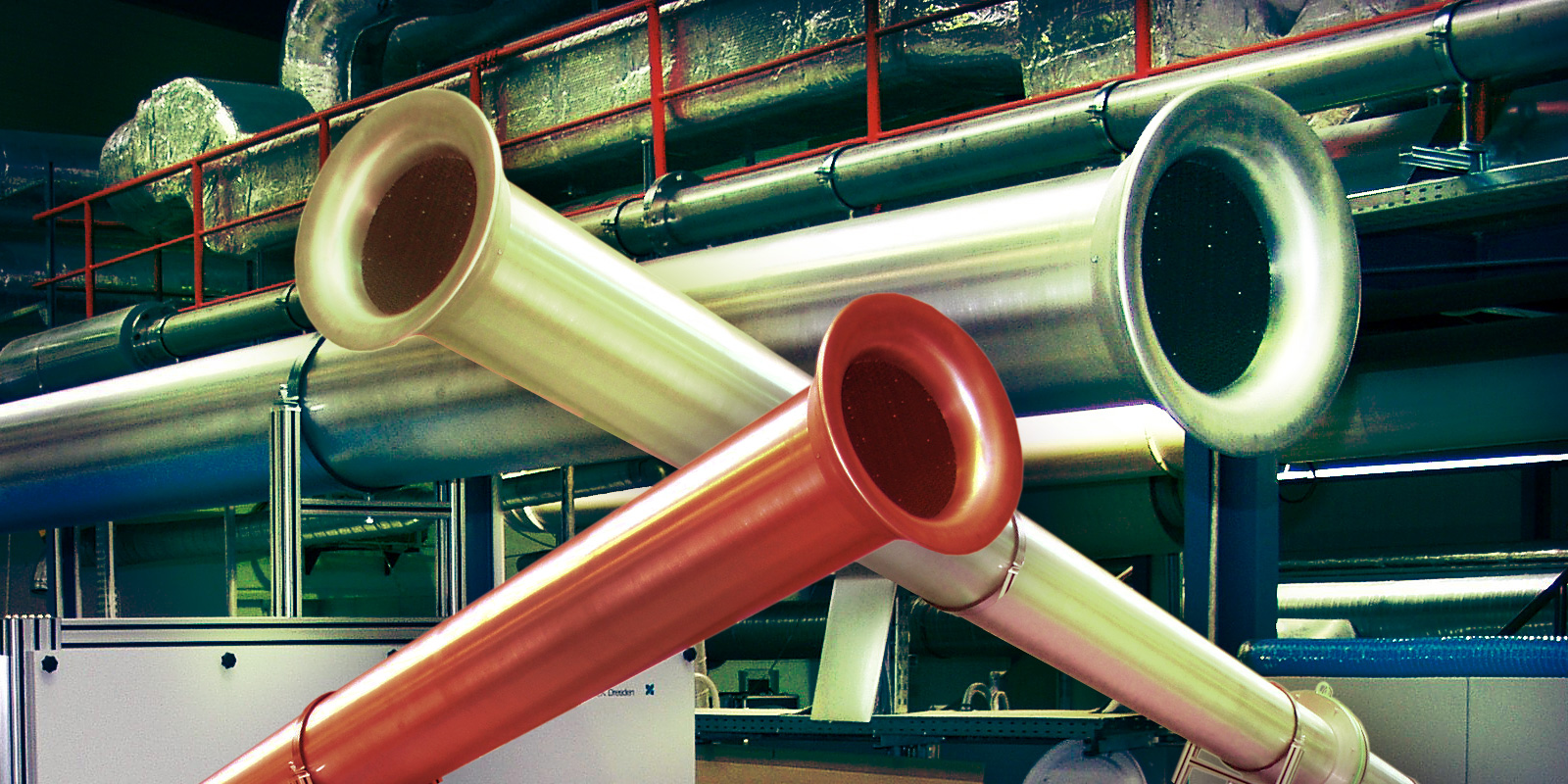
ILK Dresden develops and builds custom test rigs on behalf of customers, tailored to their individual requirements. The interdisciplinary collaboration between the departments of materials engineering, climate, energy and refrigeration technology, and measurement and control engineering enables us to provide our customers with optimal solutions. We also perform measurements on our own fan test rigs. ILK Dresden is accredited by DAkkS as a testing laboratory for fan measurements in accordance with ISO 5801, based on the requirements of ISO/IEC 17025. We would be pleased to provide you with more detailed information in a personal consultation.The measurement of the airflow rate delivered by the test fan is carried out using orifice plate flow measurement sections in accordance with DIN EN ISO 5167-2. Three measurement sections, each optimized for a different measurement range, enable a wide airflow measurement range of 0.003 to 7 m³/s (approximately 11 to 25,000 m³/h) to be covered with high measurement accuracy. The long inlet section, located upstream of the orifice plate, ensures that a fully developed pipe flow is established before the measurement section. This is a fundamental prerequisite for achieving high measurement accuracy. To further reduce flow separation at the pipe inlet and dissipate swirl, a flow straightener has been integrated into the suction section of the measurement line.When designing the measurement sections, particular emphasis was placed on achieving the widest possible measurement range while maintaining high accuracy. The resulting pressure loss caused by the flow measurement system is compensated by an auxiliary fan installed downstream of the airflow measurement section. This radial fan is speed-controlled and allows stable adjustment of the desired operating conditions for the fans under investigation.
