
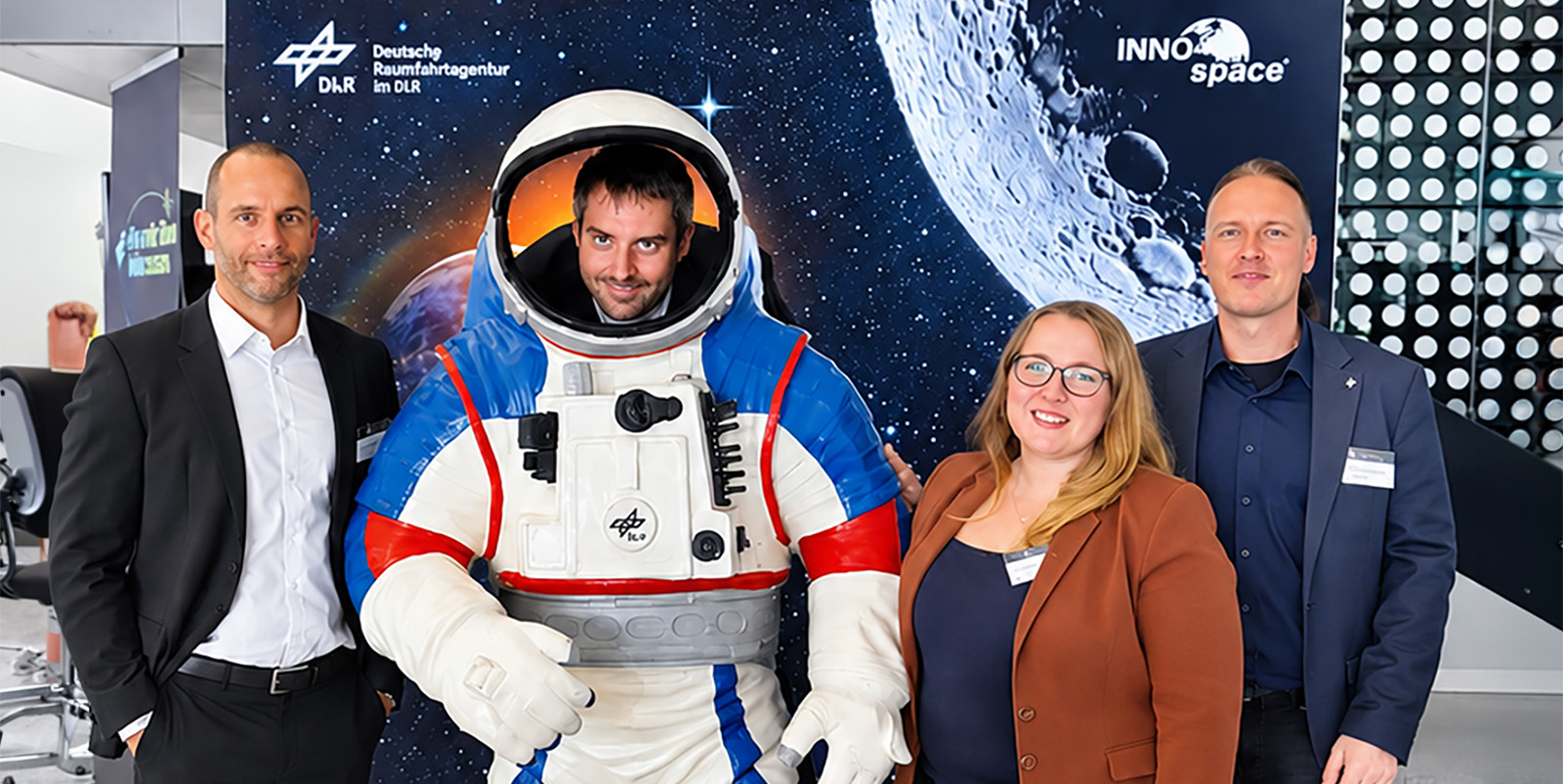
Innovative Wound Healing for Space and Earth: The StellarHeal research project was selected as one of ten outstanding success stories to mark the tenth anniversary of the international innovation competition INNOspace Masters. At the final event on November 12, 2026, in Berlin, the project team presented its research findings to date. ILK Dresden is making a decisive contribution with its expertise in cryobiology and the development of cell-based therapeutic systems.
When Space Research Advances Medicine on Earth
What happens if astronauts are injured during a space mission? Under conditions of weightlessness and cosmic radiation, wounds can heal much more slowly. At the same time, medical care options are limited.
This is where StellarHeal comes in. The interdisciplinary research project is developing a novel wound care system designed to quickly stop bleeding, promote tissue regeneration, and enable healing with minimal scarring.
The concept combines a biodegradable, hemostatic fiber matrix with a cell-containing wound-healing gel. The therapeutic cells it contains are designed to actively support wound healing. A particularly innovative feature is that the cell therapy product can be deep-frozen, stored for extended periods, and used immediately after thawing.
In this way, StellarHeal not only opens up new possibilities for medical care during long-term missions to the Moon or Mars. On Earth, too, the technology could help people with chronic or hard-to-heal wounds in the future.
Life Sciences at ILK Dresden: Cryogenics Meets Regenerative Medicine
The ILK Dresden Center for Cryo-Competence in Life Sciences plays a key role in the project. It brings together more than 35 years of expertise in medicine, biology, pharmaceuticals, and engineering with specialized know-how in the cryopreservation of living cells and tissues.
Under the direction of Dipl.-Ing. Holger Reinsch, the ILK Dresden team is developing a multifunctional cell carrier gel that serves several purposes: It protects the therapeutic cells during freezing and thawing, supplies them with nutrients, and enables their even distribution within the wound.
The research findings to date are promising: The ILK Dresden has developed a biocompatible carrier gel based on natural biopolymers and has successfully optimized the freezing and thawing processes. In experiments, up to 100 percent of the human skin cells studied survived cryopreservation.
These results highlight the potential of interdisciplinary life sciences research at ILK Dresden. The institute not only develops cryogenic processes and equipment, but also works on innovative solutions for regenerative medicine, cell and tissue preservation, and biobanking.
International Recognition for Successful Research Collaboration
As early as 2024, StellarHeal impressed the INNOspace Masters jury and won first place in the “Applied Research for Disruptive Innovation” challenge.
On the tenth anniversary of the German Aerospace Center (DLR) competition, the project has once again been recognized as one of ten selected “success stories” that exemplify innovative research and successful technology transfer.
At the final event on November 12, 2026, in Berlin, the project team presented its work as part of a poster exhibition.
This year's figures underscore the competition's international significance: 313 entries from 864 participants in 38 countries.
StellarHeal is a joint project of ILK Dresden, the Fraunhofer Institute for Silicate Research ISC, the Translation Center for Regenerative Therapies (TLZ-RT) based there, and the Fraunhofer Institute for Toxicology and Experimental Medicine ITEM.
This latest award confirms the potential of collaboration between materials research, cell biology, and cryogenics—and underscores the role of ILK Dresden as a research partner for innovative life science applications.
Additional information:
