Motivation and Objectives
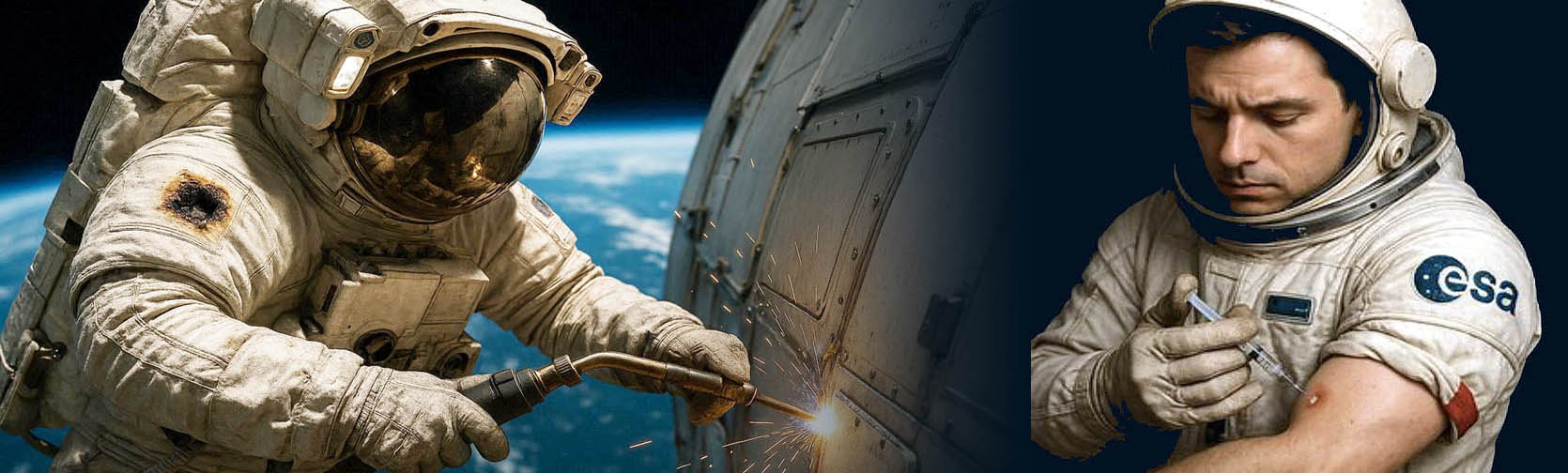
Space is a challenging work environment. The absence of gravity and cosmic radiation lead to muscle atrophy and cellular damage. Wound healing is also more difficult under spaceflight conditions. The lack of gravity disrupts cell organization and growth, while the constant bombardment of cosmic rays suppresses the immune system. This leads to delayed healing, increased wound infections, and excessive scarring, while proper medical care on space missions is very limited, and only a limited amount of wound care supplies is available. It is hard to imagine weeks of self-care involving daily wound cleansing and dressing changes. Astronauts must be able to care for themselves simply and efficiently and return to duty quickly. Our answer to this challenge is: StellarHeal.
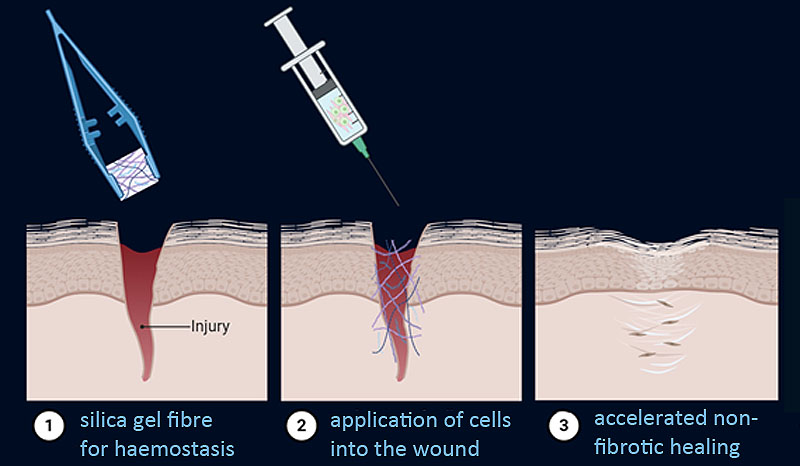
The collaborative project with the Fraunhofer Institute for Silicate Research (ISC), the Translational Center for Regenerative Technologies (TLZ-RT) based there, and the Fraunhofer Institute for Toxicology and Experimental Medicine (ITEM) aims to develop a novel wound treatment technology specifically tailored to the challenges of spaceflight. The treatment approach combines a hemostatic, biodegradable wound dressing with a cryopreservable cell therapy product and integrates aspects of materials research, somatic cell therapy, and cryobiology.
The project is carried out through a division of labor, with each project partner contributing their specific expertise: The ISC is developing a biodegradable nonwoven fabric with a hemostatic coating for wound closure, based on modern spinning processes. TLZ-RT and ITEM are using pluripotent stem cells to generate polarized skin cells that ensure scar-free wound closure, as well as immune cells that promote healing by cleansing the wound and eliminating pathogens. ILK Dresden is developing a high-viscosity cell-carrying gel used to deliver the therapeutic cells into the wound. Once bleeding has stopped, the gel is applied to the fiber mat using a small syringe. It ensures even distribution of the cells, creates a growth-promoting environment, and supplies the cells with the necessary nutrients and growth factors. At the same time, it serves as a biological cryoprotectant and enables life-sustaining cryopreservation of the therapeutic cells. With the help of this multifunctional gel, the cells are cryopreserved at ILK Dresden to ensure they survive undamaged in cryosleep even during long space missions. Once the syringe has thawed, the therapeutic agent is ready for use within a few minutes and can be administered.
Current Project Status and Outlook
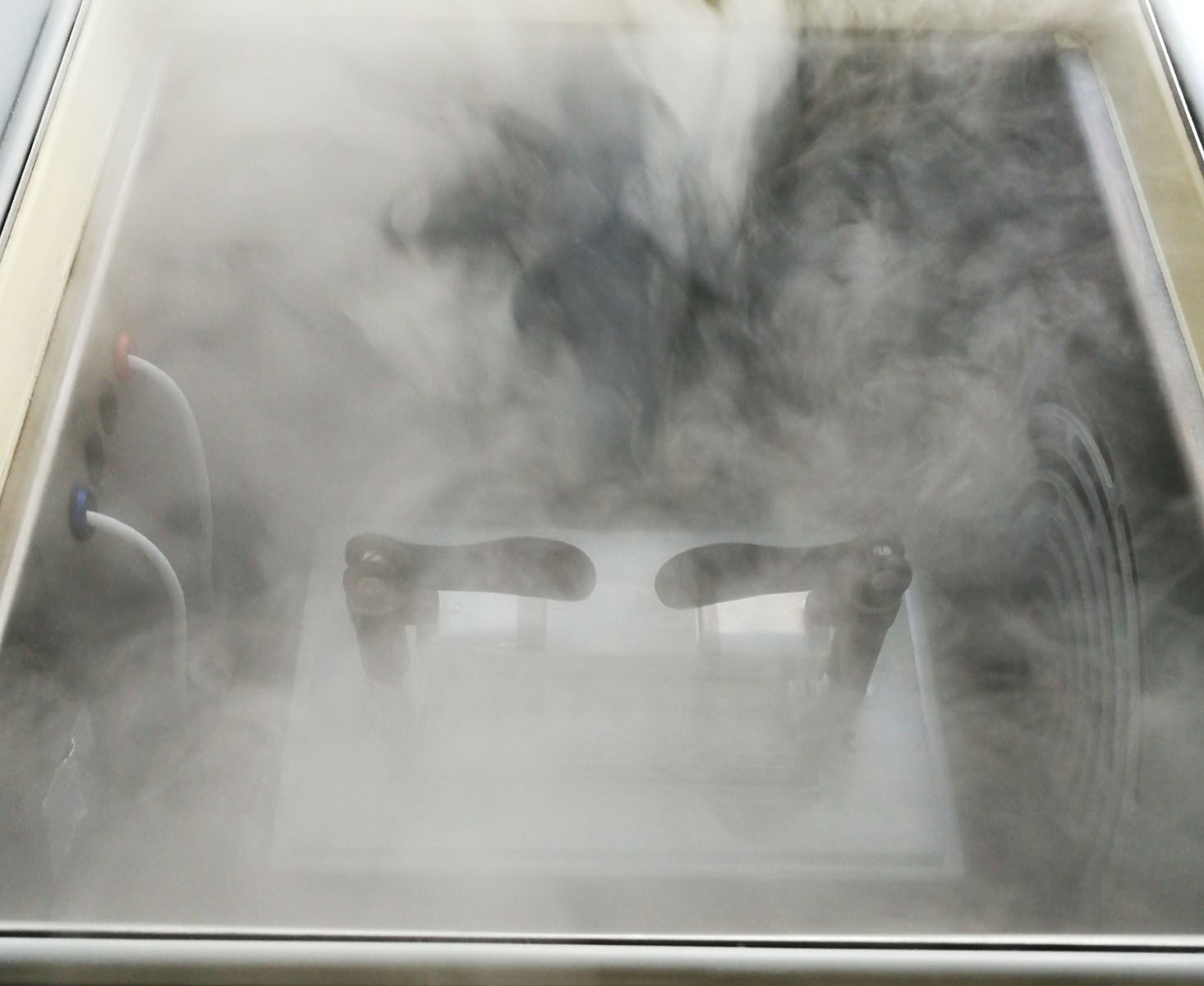
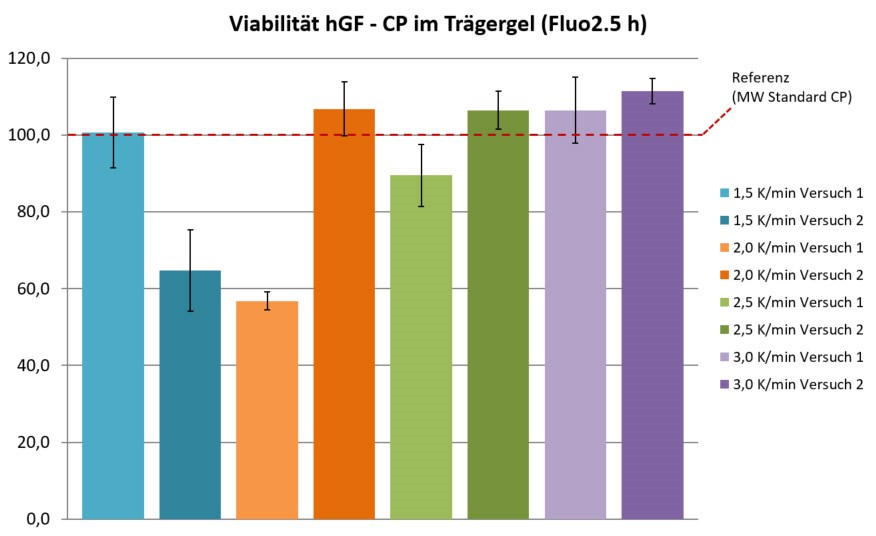
After a year of development, a well-tolerated carrier gel based on natural, tissue-specific biopolymers was developed, enabling the cultivation of human skin cells for several days. In the process, the use of problematic antifreeze additives was completely avoided. In extensive trials, the viscosity of the carrier gel was optimized so that it is firm enough to allow for a stable three-dimensional distribution of cells within the wound. At the same time, it is fluid enough to be distributed within the wound using a syringe under light pressure. In extensive trials, the freezing and thawing process was optimized to ensure that sufficient gel strength is maintained after cryopreservation. Following a special cryoprotective preculture, human donor cells were incorporated into the carrier gel. Using a custom-developed freezing rack and tailored freezing programs, the team successfully cryopreserved the cell-containing carrier gel. Up to 100% of the cryopreserved donor cells from human skin tissue (dermal fibroblasts) survived the freezing and thawing process in a cell culture dish. Based on these positive results, the project partners’ therapeutic cells are now also scheduled to be cryopreserved soon. Following successful cryopreservation, these cells will then be frozen in a product syringe.
After thawing, two in vitro models will be used to investigate whether the cells not only survive cryopreservation but can also continue to proliferate and heal wounds afterward.If all tests are successful, the cells and carrier gel can be developed into a marketable therapeutic product with the help of an industry partner or investor. For ILK Dresden, the primary challenge will be to remove animal sera and other additives necessary for cell growth from the gel and replace them with clinically approved substitutes without any loss of function. The end result of the development process is expected to be a completely novel wound therapy that, after a single application, completely regenerates even chronic wounds with a poor prognosis without leaving scars. This is intended not only to enable complication-free wound care for spaceflight but also to achieve a breakthrough in the field of clinical wound care on Earth. Time-consuming care procedures performed by clinical specialists—such as regular wound cleansing, dressing changes, antibiotic support therapies, or surgical wound debridement—are to be replaced by a single, simple treatment that leads to complete healing without the need for follow-up care.