

Development of absorption refrigeration systems and individual components
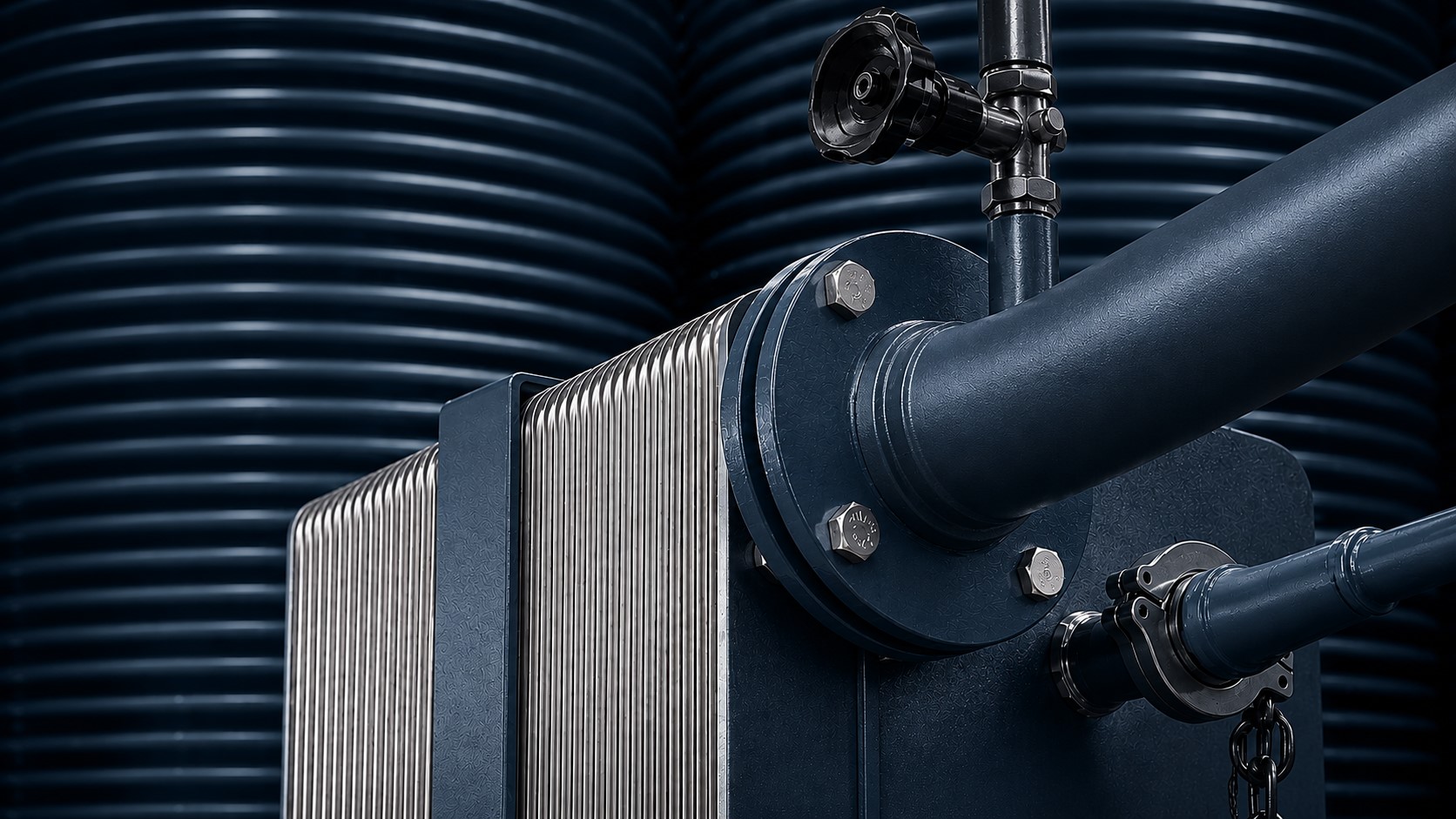
In absorption refrigeration systems (ARS), a sorption cycle is used for the (thermal) compression of the refrigerant instead of an electrically driven compressor. The process utilizes the dependence of vapor pressure on temperature and the concentration of two substances (refrigerant and sorbent). This allows waste heat from power generation, industrial waste heat, or solar heat to be used for refrigeration, thereby saving valuable electrical energy. For many years, we have been engaged in the (further) development of AKA systems using the working fluid pairs water/lithium bromide and ammonia/water, primarily in the performance range up to 500 kW of cooling capacity. In addition to testing new cycle concepts and adapting the systems to the temperature conditions of various heat sources, the focus is primarily on the individual components. In recent years, efforts to optimize heat exchangers have been intensified. In this context, both the use of structured tube surfaces (STROBA project) and the development of asymmetric plate heat exchangers for water-lithium bromide absorption refrigeration systems (AsAb project) have been successfully advanced. With the first-time use of compact plate heat exchangers in AKA, the construction volume in the low-capacity range was reduced by up to 40 %.
ILK Dresden collaborated with its long-standing development partner EAW Energieanlagenbau Westenfeld GmbH and finally we received the refrigeration award 2018 Kältepreis 2018 (2. place in the category „Refrigeration or HVAC Innovation“).
Recooling systems for low-capacity applications
Another focus is on the optimization and further development of recooling systems, which have a significant impact on the efficiency of the entire AKA, particularly in the low-capacity range. For example, the integration of water-sprayed modules for adiabatic air pre-cooling has been successfully tested. Another development approach involves completely eliminating the need for an additional recooling system in directly air-cooled AKA. This requires entirely new types of heat exchangers and system designs that are directly ventilated by air, enabling the system to be installed outdoors.
Custom solutions for niche applications
Specialized absorption chillers have been designed, adapted, developed, and operated for specific applications, such as on ships or in cascade refrigeration systems combined with compression refrigeration systems. Due to the freezing point of water, the range of applications for conventional water-lithium bromide absorption chillers is limited. Thanks to modifications and the use of Crystallisation additives and multi-componenten salt mixtures the scope of applications has been successfully expanded to include cooling at temperatures below 0 °C (the ModSE and MinusResorber projects). In addition, the working group has experience with the use of sorption cycles in compact heat transformers or booster absorption refrigeration systems. Heat transformers can be used to raise the temperature of waste heat. In booster systems, thermal compression is combined with mechanical compression.
Range of Services
In the field of thermal refrigeration, we offer a wide range of support for your needs. We looking forward to preparing feasibility studies on specific topics and design thermal refrigeration systems tailored to your particular application. Furthermore, we are available to advise you on the implementation of your projects, as well as on fault analysis and the identification of opportunities for optimization. In our test facility, equipped with a flexible media supply, we perform a wide range of thermal and hydraulic measurements on entire systems as well as individual and sub-components such as heat exchangers, pumps, or recooling systems according to customer-specific requirements. Mobile measurement systems also enable us to measure and analyze existing systems on-site at the customer’s location. A selection of projects and topics previously carried out on behalf of customers:
- Evaluation of Various Waste Heat Sources for Refrigeration
- Analysis of existing facilities and evaluation of opportunities for combined heat, power, and cooling generation, taking into account economic feasibility assessments for various clients in the food industry and the logistics sector
- Study of Waste Heat Recovery for Cooling in Commercial Vehicles
- Feasibility Study on Cooling Concrete Mixing Water Using Waste Heat from a Gas-Fired Combined Heat and Power Plant
- Measurements of heat transfer in plate heat exchangers, e.g., for use in ammonia-water heat exchangers or in the condensation of water vapor
- Vendor-neutral measurement, fault analysis, and optimization of absorption refrigeration systems
- Retrofitting a two-stage absorption chiller to improve efficiency
- Conducting airflow and temperature measurements on recooling units
- Process Analysis and Evaluation of a Prototype Absorption Chiller
- Measurement of a modified water-lithium bromide absorption chiller for cooling to 2°C
- Development and construction of a test bench for evaluating refrigerant-heat transfer fluid combinations for absorption refrigeration systems
Current and completed research projects
- Development and testing of a direct air-cooled water-lithium bromide absorption refrigeration system with adiabatic air pre-cooling and a cooling capacity of 50 kW (LAKA Project, 08/2017 – 11/2020)
- Development of special asymmetric plate heat exchangers for use in water-lithium bromide absorption chillers (Project AsAB, until 2018)
- Design, construction, and investigation of a water-lithium bromide absorption chiller using exclusively plate heat exchangers in the high-pressure section (Project PAKA, until 2016)
- Development and testing of a direct air-cooled sorption refrigeration system for solar air conditioning (LuSoKa project, until 2015)
- Use of crystallization additives and multicomponent salt mixtures in water-lithium bromide absorption refrigeration processes for cooling below 0°C (MinusResorber project, until 2011)
- Evaluation of the opportunities and limitations of solar cooling compared to reference technologies (EvaSolK project, until 2012)
- Outdoor air-driven compression-absorption cascade refrigeration system with new plate heat exchangers and sliding intermediate pressure for energy-efficient cryogenic cooling (GleiKas project, until 2016)
- Component development for highly efficient decentralized solar-assisted combined heat, power, and cooling (SolTri project, until 2013
- Structured heat exchange surfaces for absorption refrigeration systems (STROBA project, until 2014)
Selected publications and related links
Video “Thermally driven cold generation: air-cooled absorption chiller“ Winner of Video Competition 2013 Richter, M.: “Experimental experiences with an enhanced directly air-cooled water/LiBr absorption chiller “, 6th International Conference Solar Air-Conditioning, Rome 2015 Richter L. u.a.: “New Generation of Water-Lithium Bromide Absorption Refrigeration Systems with Asymmetric Plate Heat Exchangers,” DKV Presentation 11_2018, Aachen Richter L. et al.: „NH3-H2O-Absorption units with fusion plate heat exchager – design and application“; KKA 4/2009, S. 40 Richter L.: “Ammonia cascade refrigeration system with compression and absorption stages”, part 1 KKA 1/2008 page 52, part 2 KKA 2/2008 page 52 Richter L. u.a.: „“Highly Efficient Combined Heat, Power, and Cooling,” KKA Special Edition 2005, p. 58 Richter, L.: “Multi-Stage Absorption Refrigeration Systems in Combined Energy Systems”, KI Luft- und Kältetechnik, 3/2003, S. 131 Richter L.: “Adaptation of sorption refrigeration systems suitable for specific locations,” KI Luft- und Kältetechnik, 8/2000, p. 361
