
Areas of application
Characterization of dispersed systems for process optimization, quality control, or failure analysis in the food or pharmaceutical industry as well as in materials science.
Objective
Particle size and shape analysis enables precise characterization of solid particles in dispersed systems. In addition to the size distribution, the exact shape of individual particles can be determined. This improves process control, supports analysis of defects, and optimizes flow behavior, sedimentation, and reactivity for your application.
Description
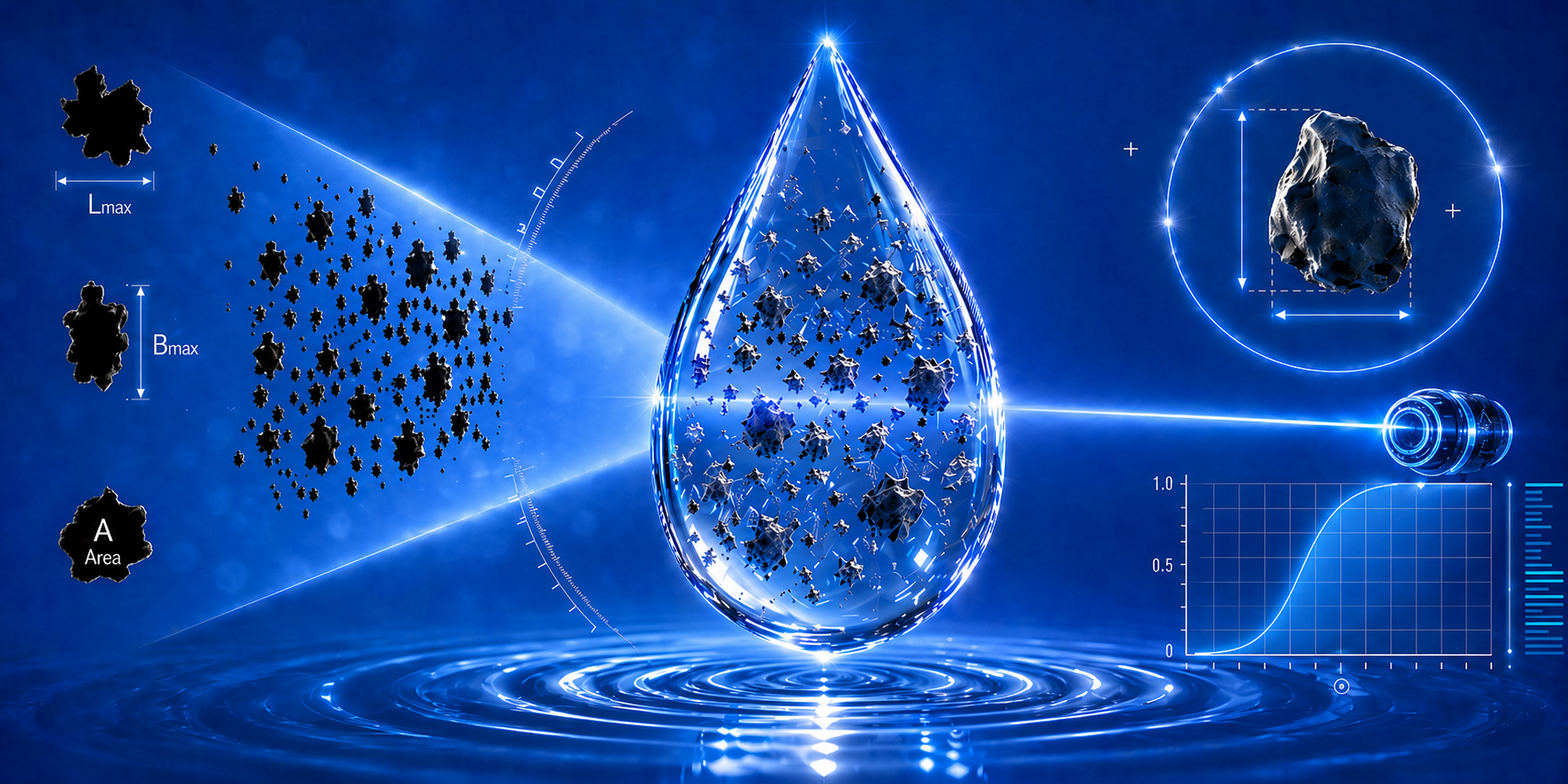
Particle measurement of solid particles in aqueous systems is based on an imaging method: particles are passed through a flow cell, illuminated, and captured as high-resolution shadow images. From these individual images, both the size and shape of each particle can be directly determined. Compared to laser-based methods, which rely on model assumptions of light scattering, this approach enables a true visual assessment of particles. As a result, not only statistical size distributions are generated, but the actual particle morphology becomes visible and traceable. In contrast to sieve-based methods, the mechanical limitation of fixed mesh sizes is eliminated, allowing reliable detection of very fine, soft, or deformable particles.The system offers a wide range of performance features: unlimited evaluation possibilities with comprehensive size and shape analysis, powerful fiber analysis (including length and diameter), as well as standardized or flexible classification. Data evaluation can be performed both as volumetric or numerical distributions. In addition, the visual inspection of particles enables direct quality control. Technically, the system covers a broad measurement range from 0.5 µm to 7,500 µm across four ISO measurement ranges and can detect even coarse particles thanks to a measuring gap width of up to 1 mm. With up to 450 images per second, it enables fast, automated size and shape analysis even for dynamic systems. Overall, this results in a flexible, high-resolution measurement method that allows both detailed single-particle analysis and robust statistical evaluation of complex dispersed systems, making it suitable for a wide range of applications.
