Combined Water Bath and Hood Leak Test
The leak-tightness of refrigeration systems is a key quality characteristic. Due to the shortage of fluorinated greenhouse gases and their sometimes drastic price increases, as well as stricter leak-tightness requirements for refrigeration systems under DIN EN 378 (2017), the standards for leak testing of refrigeration products have risen. Various methods are available for testing the leak tightness of refrigeration systems and refrigeration components, as well as for leak detection. One of these methods, frequently used in mass production, is bubble testing according to DIN EN 1779, Method C1 (water bath test). In practice, the test specimen (similar to testing a bicycle inner tube in a sink) is subjected to test gas overpressure and then placed in a test fluid, e.g., water. If leaks are present, the test gas escapes from the leak and rises as a (visible) string of bubbles in the water bath. Another method is the hood test (collection of escaping gas) according to DIN EN 1779, Method B3. In the hood test, the test specimen is placed under overpressure with a detectable gas. It is then placed in a chamber, and an accumulation time is allowed to elapse. If leaks are present, the escaping test gas leads to an increase in concentration within the enclosure. This increase can be detected using a detector calibrated for the test gas. In principle, the hood test, like the water bath test, is suitable as the sole method for leak testing refrigeration systems and their components. Both methods have their advantages and disadvantages. Bubble detection is a localized method; leaks can be located directly. A disadvantage is the subjective influence of the operator on the test and the fact that the quality of the test fluid affects the visibility of rising bubbles. The hood test is an objective, comprehensive test in which only a “pass” or “fail” result is possible. The accumulation time—the period until a detectable concentration is established within the enclosure—depends on the enclosure volume. Testing underwater significantly reduces the free volume, particularly for bulky test specimens. This is achieved by covering the test tank. Thus, the enclosure volume is limited only to the air space between the water surface and the cover.
Approach and Project Objective
The innovative approach of this R&D project consists of combining the C1 bubble detection method according to DIN EN 1779 (water bath test) with the B3 method for collecting escaping gas according to DIN EN 1779 (hood test), thereby leveraging the respective advantages of each. Figure 1 illustrates the principle of the combined test. The target detection limit is an equivalent of 5 g/a of refrigerant. This leakage rate also represents the detection limit of the water bath test. Combination of water bath and envelope leak testing, leveraging the respective advantages:
- Objectivity of the envelope test with significantly reduced accumulation time and less effort required by the technician to locate leaks
- The detection sensitivity is approximately 5 g/a of refrigerant
- Application: Component testing in refrigeration technology
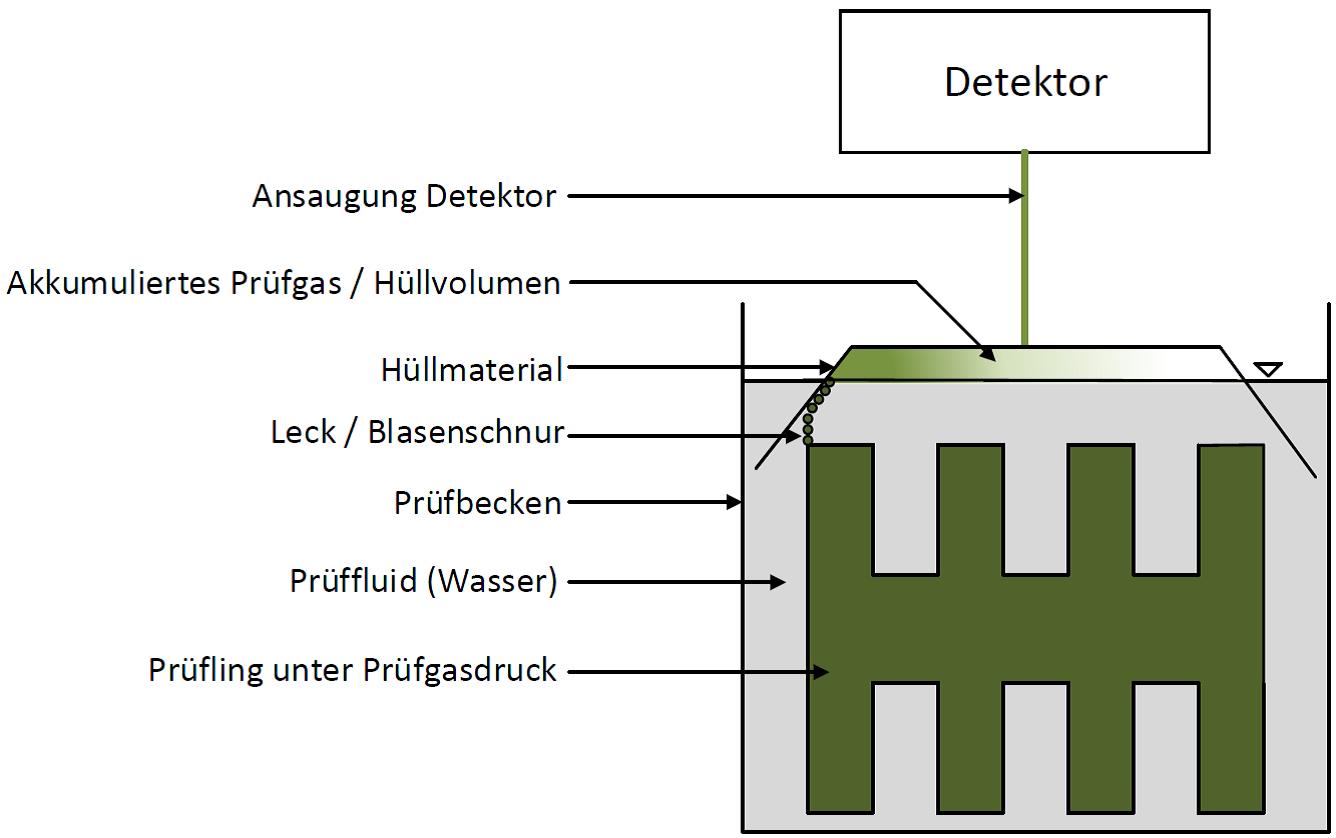
The test is conducted in two stages. The first stage involves the hood test. This determines whether a test specimen is “leak-tight” (IO) or not (NIO). This first stage will be largely automated. If the test specimen is determined to be an IO component, the visual bubble test is omitted. In the event of an NIO result, the second test step is a visual water bath test performed by the operator. Both tests are conducted in the same test tank and using a single application of test gas, saving time. The operator only becomes active if an NIO signal is received during the hood test. In summary, this project achieves the following advantages compared to the water bath test alone:
- Distinction between “true” leaks and air bubbles that remain “stuck” to the test specimen after immersion.
- Visual inspection only upon an NIO signal from the hood test procedure (no constant monitoring required)
Compared to the hood test alone:
- Reduction in accumulation time, as the free volume is displaced by the water, thereby limiting the enclosure volume to only the air space between the water surface and the cover
Through the combination of methods:
- Integrated testing (hood test method) with local methods (water bath test) in a single test setup and in a single operation
- Time savings (only personnel costs, as auditors are only active in NIO cases)
- Reliable, dependable test result (leakage rate gas detector)
- Reduction of subjective influences by the operator in water bath testing
- Visualization of leaks is possible and only necessary after a failing grade (NIO) signal from the hood test.
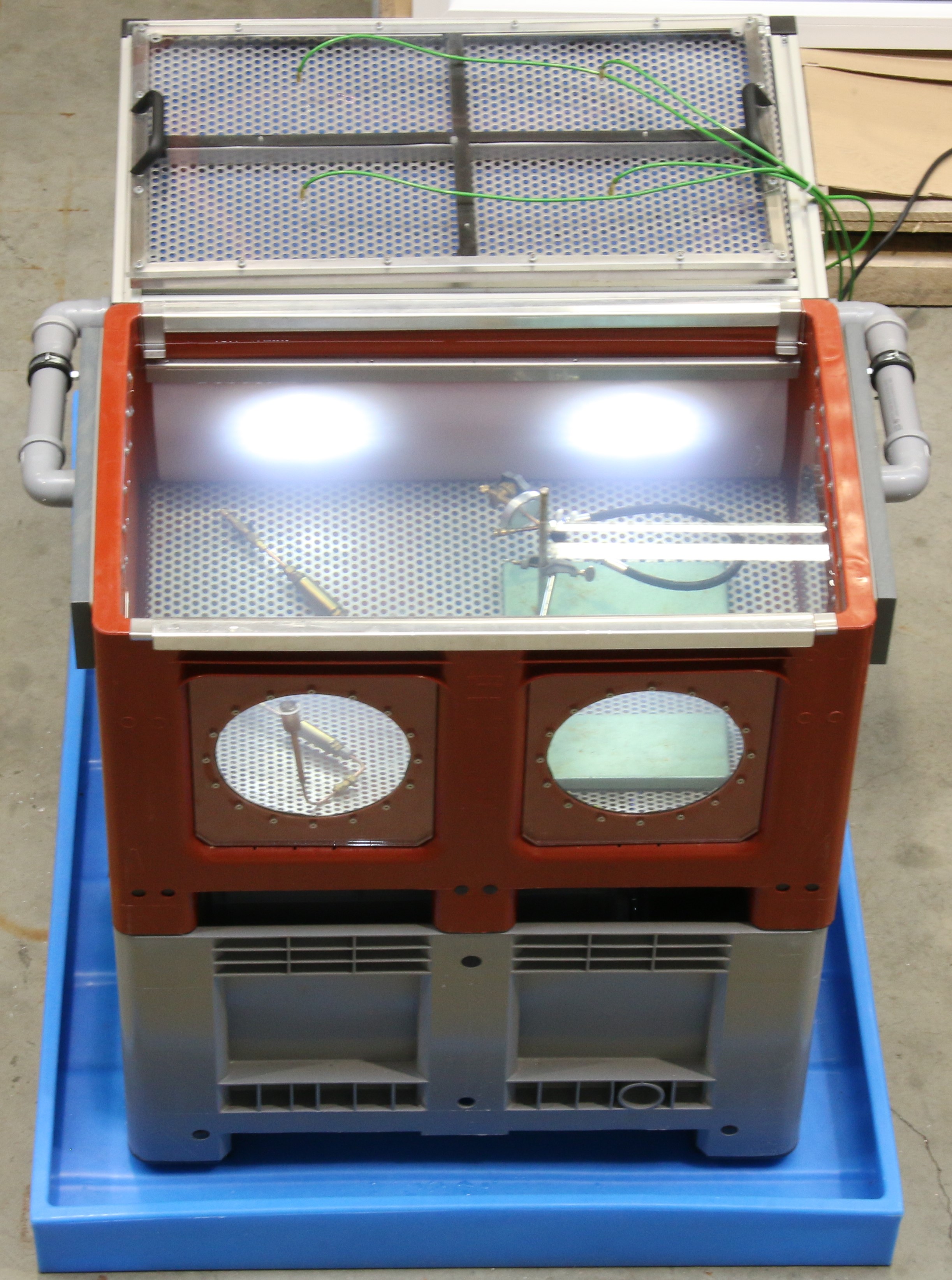
Project results
The project aimed to combine the water bath and shell testing methods by leveraging their respective advantages; in other words, the method enables both the quantification of the leakage rate (objectively, independent of the operator) and the localization of leaks (by the operator). Using a functional prototype, the combined testing methods were optimized with respect to a lower detectable leakage rate of 5 g/a of refrigerant. A specially developed control system largely automated the testing process, so that the operator only needs to actively locate a leak when the control system signals a non-conformity (NIO). Other key areas of focus included water treatment and purification in the test basin, as well as the development of suitable leaks for calibrating the functional prototype. The latter areas of focus included additional visualization aids such as optimized lighting and high-contrast backgrounds. Furthermore, a method for expelling test gas from the basin water was developed, which is used in particular following the testing of highly leaky components and thereby allows for continuous testing operations. The developed combination of methods makes it possible to minimize the subjective influence of the operator during the classic water bath test. Compared to other (potentially) objective testing methods, such as the classic envelope test, the combination of methods achieves a significantly reduced accumulation time. Compared to other integral testing methods, the combination of methods also allows for (manual) localization of leaks. The worker’s task is facilitated by a variety of visualization aids. In automated testing mode, the worker only actively performs visual leak detection when the control system signals a non-conformance (NIO). The solutions developed within the project for specific challenges of the classic water bath test (such as water treatment, lighting, test specimen tilting device, oil barrier, and test leak) can also be used as individual components to optimize existing bubble test baths.