
Areas of application
All sectors that apply and use hydrogen, no matter whether as process gas, energy source, storage fluid, or as research topic.
Objective
The negative influence of hydrogen on the properties of materials with fluid contact is often not well known and may lead to high risks for development and application. By testing and quantifying the influence of hydrogen on material properties and component behaviour, costs as well as risks will be reduced beforehand.
Description
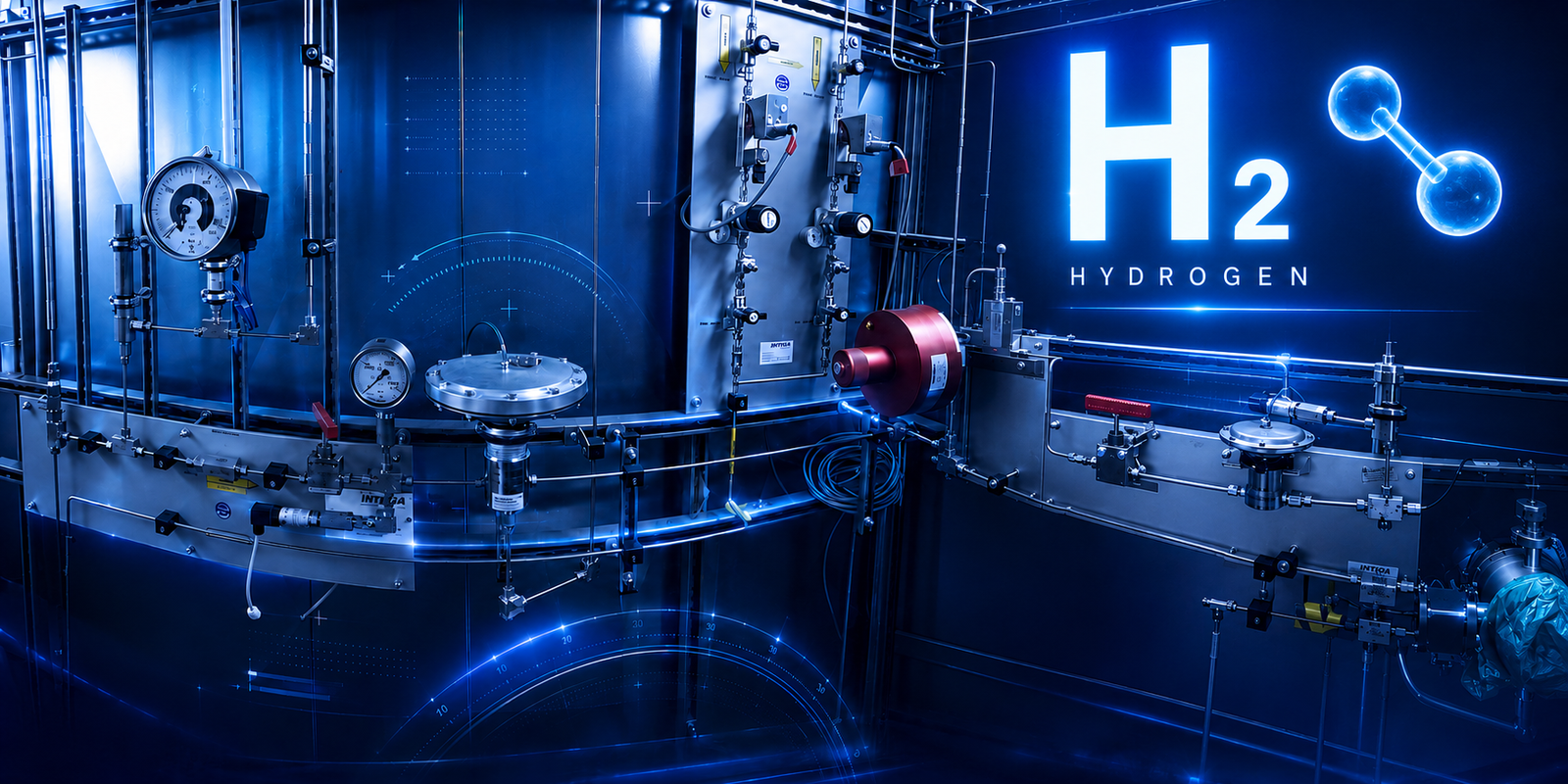
ILK Dresden offers a wide selection of possibilities for evaluating the hydrogen compatibility of metallic and non-metallic materials and components. Among other things, these include the quantification of hydrogen embrittlement by means of static tensile tests (up to 100 kN from 77 K to 300 K, ex situ), the quantification of hydrogen permeation (from 4 K to 300 K up to 1000 bar, in situ), and leak tests for hydrogen systems. Small samples can be conditioned in situ at up to 200 bar and +200 °C beforehand to maximise the hydrogen deposit for worst-case scenarios. Moreover, all samples (even larger ones, e.g. whole cryostats) can be submitted to thermal cycling beforehand.
As a feature, ILK Dresden also offers a hydrogen-related analysis of special materials. For example, these can be permanent magnets (e.g. Sm2Co5, Sm2Co17, NdFeB), which may be attacked and dissolved by in-situ hydrogen. Moreover, these can also be high- and medium-temperature superconductors (e.g. based on BSCCO, REBCO, MgB2), whose electric and magnetic performance may be reduced by in-situ hydrogen (e.g. by directly cooling them with liquid hydrogen). For this, ILK Dresden possesses a suitable test stand that allows for the in-situ quantification of hydrogen-induced material degradation of superconducting cables and bands in the temperature range from 20 K to 300 K in magnetic fields up to 100 mT.
