
Areas of application
Buildings equipped with HVAC-systems for heating, cooling or air-conditioning such as office and administrative buildings, schools and universitys, industrial facilities and manufacturing plants
Objective
Modern HVAC-systems plays a key role in ensuring comfort, energy efficiency, and indoor air quality in buildings. Demand-oriented intelligent control and regulation concepts enable indoor climate, air exchange, and temperature control to be optimally adapted to the respective use.
Description
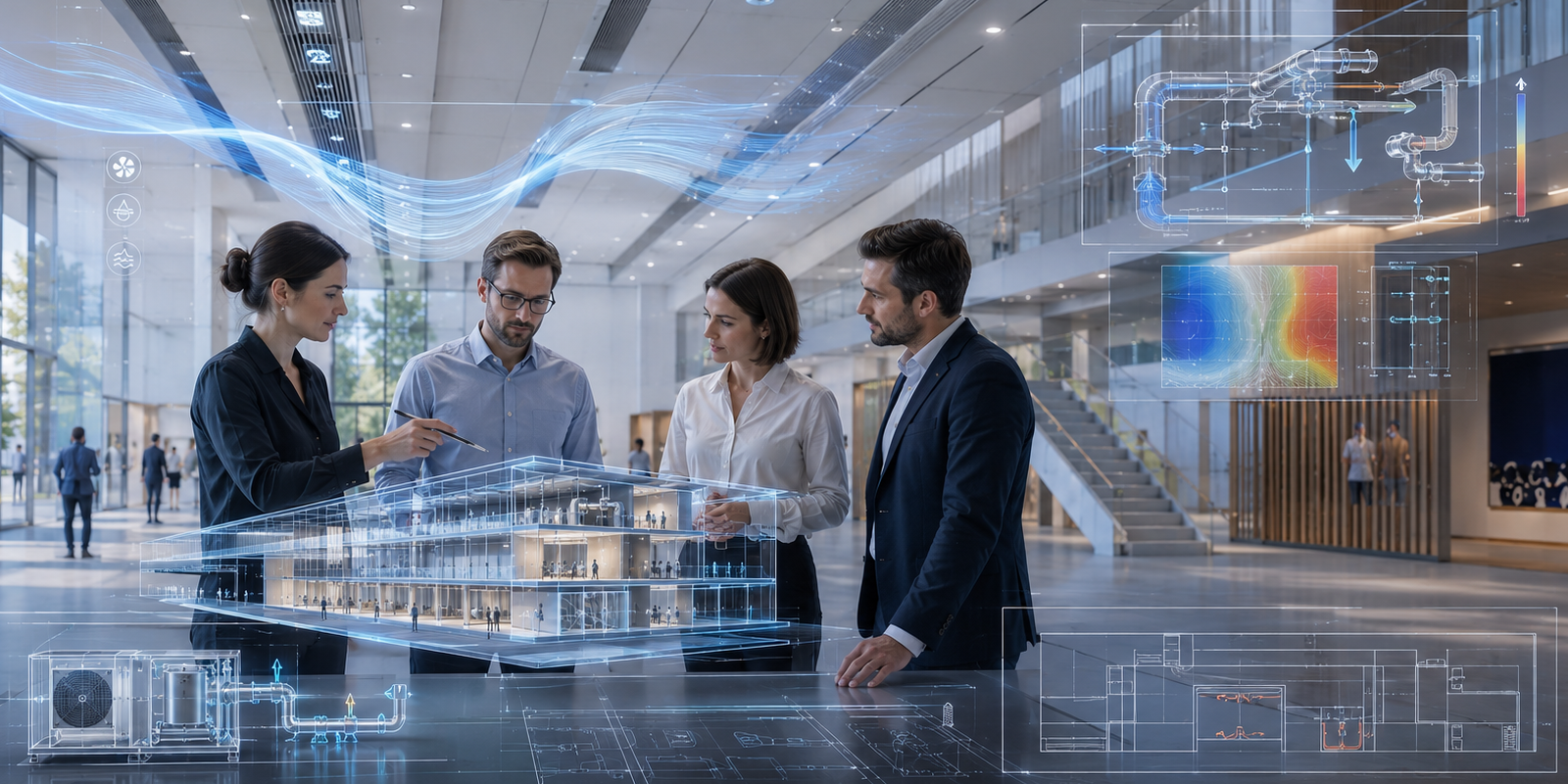
Air conditioning and ventilation technology is an essential part of modern building services engineering and plays a key role in ensuring energy efficiency, occupant comfort, and indoor air quality. Due to the increasing complexity of modern buildings and their operational requirements, intelligent ventilation, air conditioning, and control systems are becoming increasingly important. They establish the connection between design requirements, energy performance targets, and efficient building operation.Demand-oriented design of HVAC systems enables the energy-efficient provision of thermal comfort, hygienically safe indoor air quality, and optimized air exchange rates. Modern system concepts integrate energy-efficient components, heat recovery technologies, and intelligent control strategies for demand-based operation.Technical monitoring of HVAC systems serves the continuous supervision and evaluation of operating conditions, airflow rates, temperatures, pressure conditions, and energy consumption. Through continuous comparison of target and actual values, deviations, inefficient operating modes, or malfunctions can be identified and optimized at an early stage. This sustainably improves energy efficiency, operational reliability, and system performance.Systematic commissioning in accordance with VDI 6039 ensures that HVAC and refrigeration systems are professionally tested, balanced, and coordinated across all disciplines. This guarantees that all systems operate in accordance with the planned functional requirements and achieve the intended comfort and efficiency targets.Energy monitoring forms the basis for evaluating and optimizing the energy performance of technical building systems. Continuous acquisition and analysis of energy consumption data enables the identification of energy-saving potential, reduction of operating costs, and support of energy management systems, for example in accordance with ISO 50001.HVAC technology, technical monitoring, commissioning management, and energy monitoring have become essential components of sustainable building quality management. Through integrated planning, intelligent automation concepts, and systematic operational optimization, energy-efficient, comfortable, and future-proof building concepts can be achieved over the long term.
