Areas of application
Non-residential buildings equipped with building services systems, such as cultural and administrative buildings, as well as buildings used for teaching, education, medical or industrial purposes
Objective
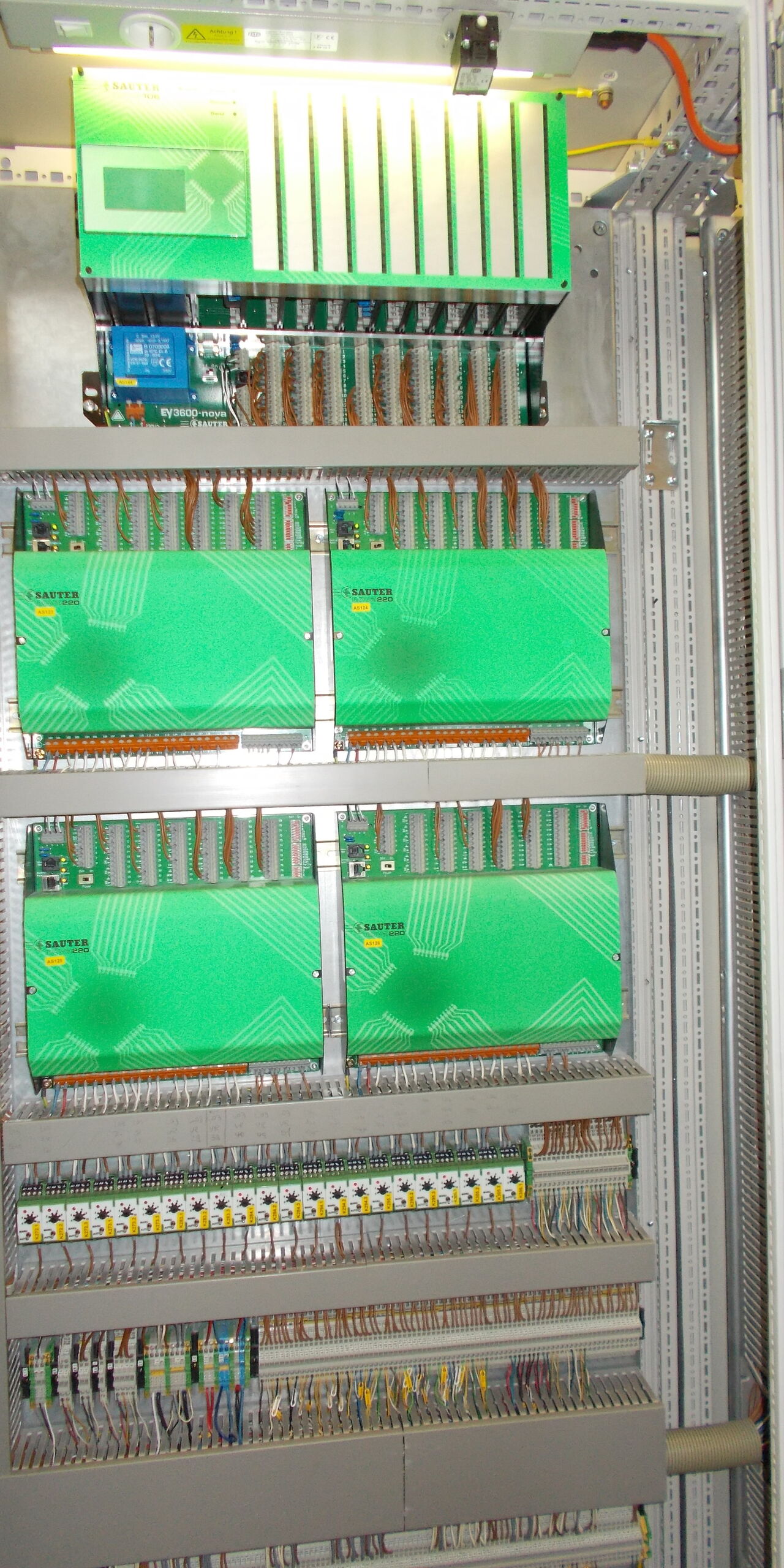
Building automation systems make buildings more efficient, comfortable, and secure. With the help of intelligent systems and technologies, building functions can be automatically controlled, monitored, and optimized. For many types of buildings, the law already requires digital monitoring and control of technical systems.
Description
Over the past few decades, building automation (BA) has evolved into a key discipline within building services engineering due to the increasing complexity of building systems and their technical infrastructure.
In addition, building automation is increasingly integrating building assemblies and components that were previously considered in isolation. Building automation integrates their functions—such as demand-based lighting control, shading systems for summer heat protection, or window drives for natural ventilation—into a holistic operating system to improve energy efficiency and comfort, and not least to reduce ongoing operating costs.
In connection with its services for the design and optimization of building services systems, ILK Dresden has also developed specialized expertise in the field of building automation, particularly for highly complex laboratory buildings, as well as arts and cultural facilities and administrative buildings of the Free State of Saxony.
We have particular expertise in the renovation and restoration of historic buildings in accordance with preservation guidelines, such as the Dresden State Art Collections (including Dresden Palace and the Albertinum), the German Hygiene Museum in Dresden, and the Saxon State Theaters (including the Semperoper, the Großes Haus, and the Kleines Haus).
For projects at a university, in order to improve the operational reliability of the local building automation network, individual room control systems for specific laboratories were designed as a local IP network with redundant paths (ring configuration) extending to the interface with the campus building automation network (network switch in an IT room).
By combining these redundant paths with specially designed automation and network components that support failover mechanisms, it is possible to achieve a very high level of reliability for critical systems using a specialized network protocol (Rapid Spanning Tree Protocol / RSTP, IEEE 802.1w).
In addition to developing concepts for the installation and retrofitting of building automation systems, ILK Dresden also provides basic training for operations and maintenance personnel.
To share with interested parties the knowledge we have gained over many years through research projects and applied in practice regarding the planning of museum facilities, we have published the “Compendium of Museum Technology” (ISBN 978-3-8007-5733-6) in collaboration with colleagues in the field.