
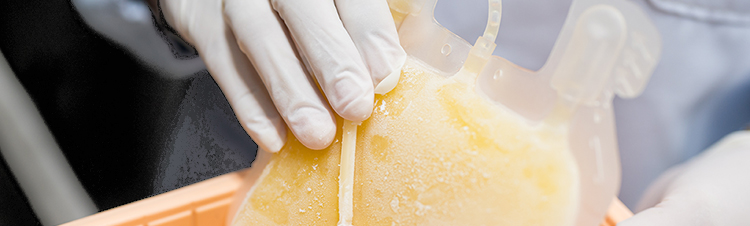
Blood plasma can be stored for two years at -30 to -40 °C. But what if it needs to be stored for 20 years?
Medical samples such as blood and plasma are frozen to make them storable for use as needed. The storage temperature has a major influence on the shelf life of blood products. The physical law that describes the underlying relationship is called van't Hoff's rule or RGT rule. It states that chemical processes, such as sample decay, slow down at low temperatures. Therefore, the shelf life of blood products can be doubled by lowering the temperature by 10 °C.
For economic reasons, plasma reserves for medical purposes are stored at temperatures between -30 °C and -40 °C. In this temperature range, blood plasma has a shelf life of two years. However, this is not sufficient for some purposes. For medical studies (e.g., NAKO), plasma samples must be collected over a period of 20 years in order to evaluate them collectively. They are collected in a biobank, which can hold several million individual samples. Here, they are stored in large tanks using liquid nitrogen. At -180 °C, the plasma has a virtually unlimited shelf life.
The ILK Dresden has computer-controlled freezing devices that can gently freeze blood plasma at a defined cooling rate. For scientific purposes, the frozen plasma is stored in special freezers at temperatures between -75 °C and -85 °C. It can then be kept for at least 10 years.
