
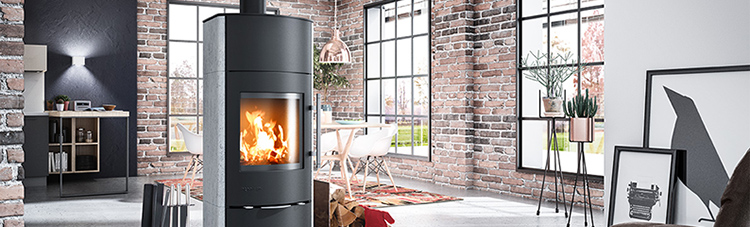
While the room is very comfortable at an air temperature of 20 °C and the heat radiation from a crackling open fire...
...the combustion chamber temperature in the stove must average 1000 °C.
In the direct flame area, temperatures rise even higher to around 1100 °C. The best way to tell if the air in your wood-burning stove at home is set correctly is to check that the combustion chamber walls and viewing window are free of soot...
With good air metering and airflow, wood can be burned in a wood-burning stove with low emissions. In addition to the mandatory compliance with legal requirements for emissions – the 1st BImSchV (“Bundes-Immisionsschutzgesetz” = Federal Pollution Control Act) – there is even more that can be done: modern wood-burning stoves work with catalytic converters in the exhaust gas path to further reduce the harmful gases carbon monoxide and unburned hydrocarbons, and some even use electronic combustion control systems. The user is guided by a smartphone app, which attempts to ensure optimal combustion and further reduce dust emissions.
But we believe there is still more to be done: At ILK Dresden, we are currently working on ways to further reduce dust emissions without compromising on technical complexity and user-friendliness. To accomplish this task, we have access to test bench technology with state-of-the-art gas analyzers and particle measuring devices that enable us to perform online measurements and immediately evaluate any changes.
Wood-burning stoves are fireplaces that actively contribute to climate protection by using wood as a renewable energy source. The aim is to make these fireplaces so low in emissions that they can continue to do so for us in the future.
