
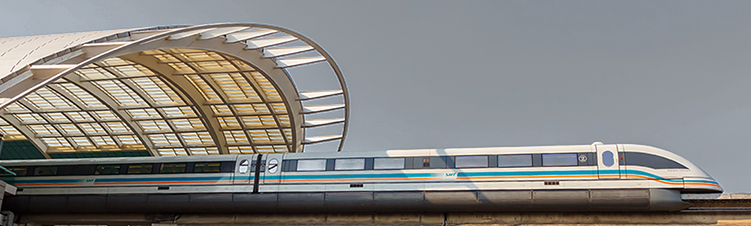
Superconducting magnetic coils cooled with liquid helium at -196 °C are necessary to generate a strong magnetic field for maglev trains such as the Transrapid. Superconductors have the property that when cooled below their so-called transition temperature, they are no longer penetrated by an external magnetic field, but rather this magnetic field surrounds the superconductor (Meissner-Ochsenfeld effect). If the magnetic field is strong enough, the superconductor can then float above the magnetic field. By changing the polarity of the magnets and applying a sufficiently large initial impulse, frictionless propulsion is achieved, which drives maglev trains.
The Transrapid, which was developed in Germany and was initially intended to connect Berlin and Hamburg (but was discontinued for cost reasons), began operating in Shanghai in 2002 between the city center and the airport. The 31 km route is covered in 7 min 40 s. The Transrapid has a top speed of 430 km/h.
