
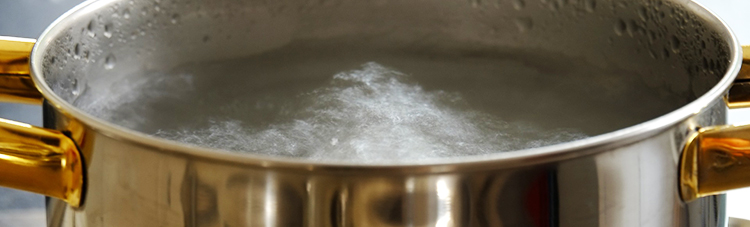
At an external air pressure of 1.013 bar, the phase transition from liquid to vapor occurs in water at a temperature of 100 °C. The water boils and in an open system (e.g., a saucepan), the temperature remains constant until all the water has evaporated.
But be careful: the lower the air pressure, the sooner water starts to “boil.” This can happen at temperatures below 100°C. This phenomenon can be observed in the mountains. On the Zugspitze, Germany's highest mountain (2,962 m), water boils at 90 °C.
At the so-called “triple point,” the pressure conditions are so special that water exists in all three states of matter at the same time (liquid, gaseous, and solid — as ice)! The water boils while simultaneously freezing. The heat required for evaporation is “extracted” from the water itself, causing ice crystals to form within the liquid.
The ILK Dresden is exploiting this physical property in the AQVA HEAT project, among others, and is researching how we can use water to heat or cool our buildings. AQVA HEAT is a climate-neutral process that could significantly reduce CO2 emissions, e.g., from heating with coal, gas, or oil. It should be noted that the CO2 emissions of each individual German citizen for heating alone amount to 1.75 t per year. In the course of the “heat transition,” new approaches for tapping reliable heat sources must be found for large-scale, sometimes short-term power supplies.
