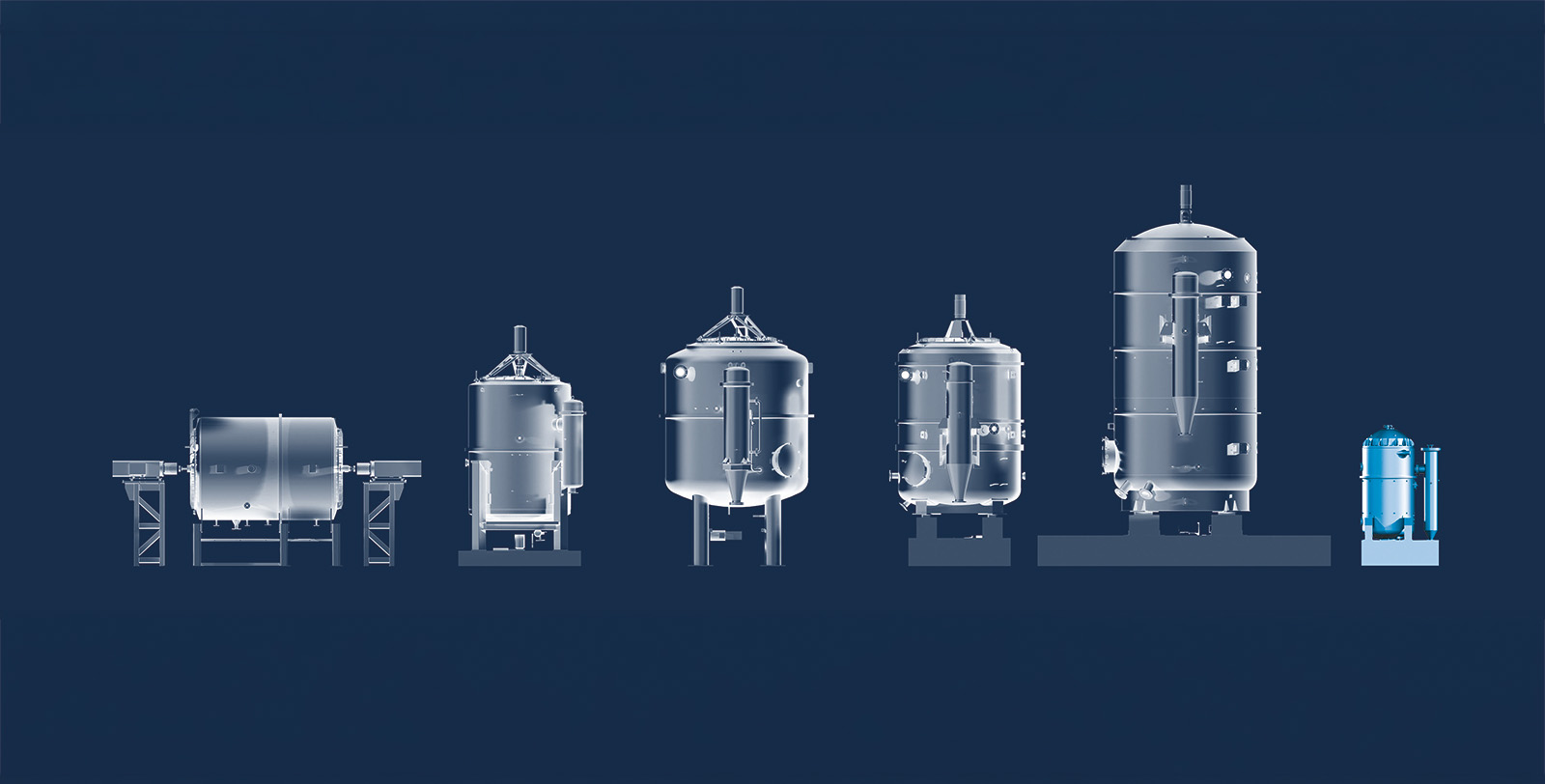
The development of an 80 kW vacuum ice slurry generator will significantly expand the range of applications for this technology in the future. Its lower capacity and smaller size compared to its larger counterparts pave the way for numerous applications in the fields of cold storage and heat recovery.
Dipl.-Ing.
Marcus
Honke
Areas of application
Cold storage and distribution; heat extraction from water bodies and ice storage in combination with heat pumps; production of ice for industrial use, e. g. in food processing
Objective
ILK Dresden has developed a vacuum ice-chiller based on a special steam turbo compressor with a diameter of 2 m (1st place in the 2016 German Refrigeration Award). This enables to implement systems in a rage of 200–500 kW power.
Process of Direct Evaporation - ice slurry production
Procedure
A vacuum ice slurry generator utilizes the triple-point process: Water evaporates in a “stirring tank” at 0 °C and a pressure of 6 mbar. The resulting water vapor is extracted by a turbo compressor, compressed to a higher pressure, and condensed. In this process, the heat of condensation is transferred to the cooling water. Heat is required to generate the water vapor in the evaporator, which is extracted from the liquid water. This causes ice crystals to form on the water’s surface and ultimately results in a pumpable water-ice mixture (ice slurry). The ice slurry is continuously pumped out of the evaporator and conveyed, for example, to a storage tank. In applications involving water-source heat pumps, the ice slurry is returned to the water body. The core component of the developed low-capacity vacuum ice generator is a new turbo compressor. Individual parts of the compressor, such as the impeller and drive, had already been developed in previous projects. As part of this project, extensive work was carried out on the sizing, design, and fluid dynamics optimization of the compressor housing. Other key areas of focus included the vibration optimization of the entire system, the design of the shaft-hub connection, and the sizing and design of the other subcomponents of the ice generator, such as the tank, the agitator in the evaporator, and the direct condenser.
Findings
Following initial unsuccessful test runs, extensive and time-consuming work was required—contrary to the original plan—to identify, implement, and verify the functionality of a suitable shaft-hub connection. This work resulted in an optimized, lightweight impeller. It has an outlet diameter of 40 cm and rotates at 21,000 rpm. At the same time, the entire system (demonstrator) was assembled, consisting of a two-part stainless steel vessel with a compressor mounted on top. The compressor has since been successfully operated at rated speed with good results. The next step will be the commissioning of the entire test infrastructure.