
Areas of application
Cooling of, for example, superconducting current limiters, SQUID sensors (highly sensitive magnetic field sensors) or test specimens
Objective
- Operating temperatures 4 K to 350 K
- Automatic filling and recondensation
- Geometric optimisation for vacuum hold time and minimised evaporation losses
- Leak rates down to 10-10 mbar l/s
- HF noise < 1% in the range from 10 Hz to 2 MHz
- Magnetic noise less than 3 fT/Hz½
- Very small cold-to-warm distances, down to 2 mm for finger cryostats
Description
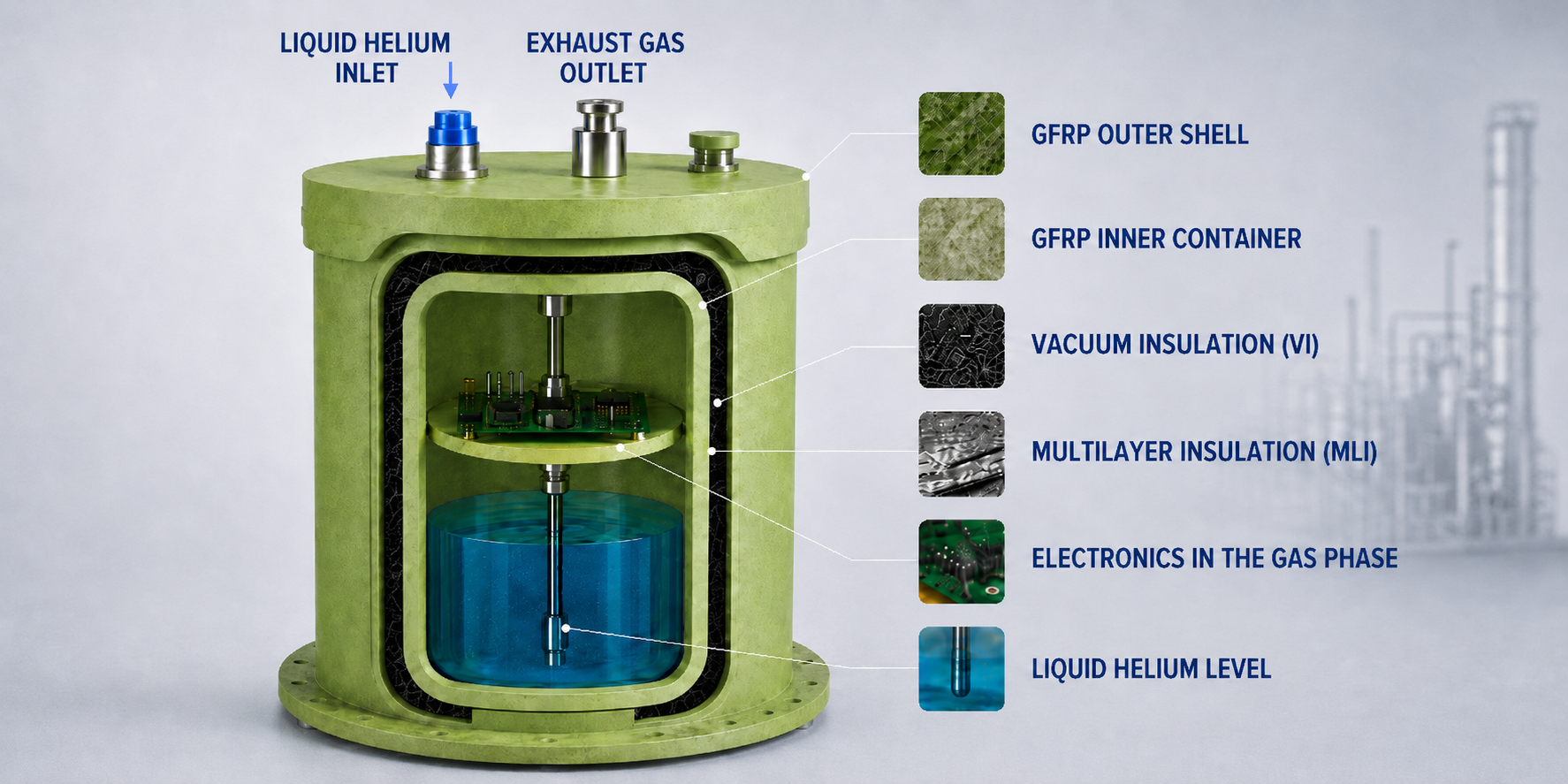
Application-specific cryostats made from metallic materials or, alternatively, fibre-reinforced plastics (e.g. glass fibre-reinforced epoxy resin – GFRP) are being developed for the cooling of sensors using liquid nitrogen or helium. The systems are modular in design and can be adapted to meet specific customer requirements in terms of geometry and functionality.
In particular, metal-free GFRP cryostats with specific properties have been developed for use in superconducting current limiters and in SQUID sensors (highly sensitive magnetic field sensors). These designs can also be configured as pressure vessels if required.
We have extensive experience in the design of cryostats, as well as the necessary manufacturing and testing expertise.
GFRP cryostats for materials testing can be designed with an adjustable cold-to-warm distance along the z-axis and operated independently of orientation. For applications involving the measurement of extremely weak magnetic fields, such as in cardiac or cerebral diagnostics, adjustment mechanisms for precise positioning of the sensor in the x-y plane can be integrated, and the cryostat can be equipped with swivel mounts.
Full orientation independence, including 360° rotation, is achievable while maintaining constant cooling performance and high temperature stability. GFRP cryostats are also available with solid-state insulation.
In contrast, laser-based gas analysis using diode lasers requires metallic cryostats with very high demands on temperature stability, achieving fluctuations as low as 3 mK at the sensor location.
