
The current Building Modernization Act took effect on July 29, 2026. The new Building Modernization Act changes the framework for heating buildings. The greater openness to different technologies expands the options available to owners, operators, planners, and manufacturers—while also increasing the importance of a thorough technical and energy assessment. ILK Dresden provides support in the development, analysis, and optimization of suitable solutions.
The new regulations are intended to make the system more flexible and practical. The previous uniform requirement of a minimum 65 percent share of renewable energy in heat supply has been eliminated.
--> This gives owners greater freedom in choosing their heating technology.
The goals of a more climate-friendly and efficient building energy supply remain in place. For example, the new regulations stipulate mandatory and subsequently increasing shares of climate-friendly fuels for newly installed gas and oil heating systems starting in 2029. At the same time, federal funding for energy-efficient buildings will be continued and adjusted.
Greater openness to technology—a greater need for well-informed system decisions
With greater freedom of choice, a key technical question comes more sharply into focus: Which solution is suitable for which building and which use?
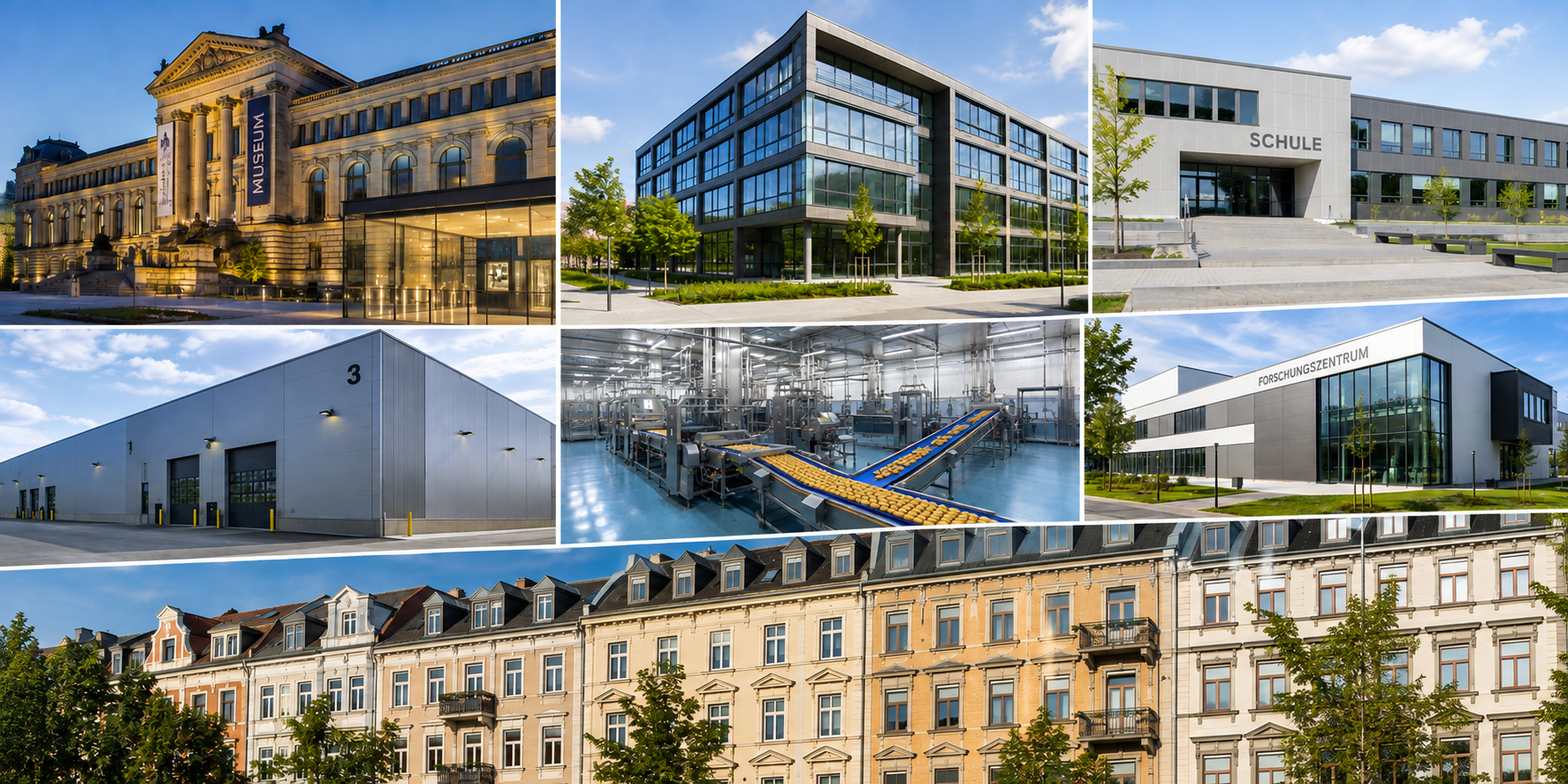
This is because the energy-efficient and economically optimal heating and cooling system for an apartment building can differ significantly from that of an office building, a school, a museum, a research facility, or an industrial and manufacturing plant. Operating hours, temperature levels, heating and cooling requirements, existing infrastructure, and requirements for ventilation, indoor climate, and process heat all influence the selection and sizing of the systems.
Accordingly, the applicable regulations cover more than just heat generation. Among other things, it includes requirements for existing buildings as well as for heating, cooling, and ventilation systems, hot water supply, heat recovery, and the energy optimization of technical systems. For non-residential buildings, Section 56 now defines building automation. For systems with a rated output of 70 kW or more, at least a monitoring system must be in place; for new buildings with a rated output exceeding 290 kW, building automation and commissioning are also required.
ILK Dresden provides support in developing efficient solutions
It is precisely at this intersection of legal frameworks, energy efficiency, and technical implementation that the core competencies of the Dresden Institute for Air Conditioning and Refrigeration Technology (ILK Dresden) lie.
As an independent research institute, ILK Dresden supports companies and public clients throughout the entire development chain—from the initial idea through research and development to prototypes and market-ready solutions. In doing so, the institute adopts a technology-neutral, practical, and solution-oriented approach.
Depending on the building, its use, and the technical requirements, the institute can, for example, investigate and further develop heat pumps and refrigeration machines, hybrid supply concepts, heat and cold storage systems, ventilation and air conditioning systems, heat recovery, and the energy optimization of existing systems.
Simulations and experimental studies make it possible to compare different system variants under defined conditions and to validate technical solutions as early as the development process.
From the Legal Framework to the Technically Optimal Solution
The increasing openness to different technologies offers the opportunity to align building services more closely with the actual requirements of the specific property. The decisive factor here is not merely the choice of a particular technology, but the interplay between the building, building services, energy source, operating strategy, and usage.
ILK Dresden supports manufacturers, designers, system integrators, operators, and public contracting authorities in scientifically investigating these interrelationships and deriving energy-efficient and technically sound solutions from them.
Are you working on the modernization of heating, cooling, air conditioning, or ventilation systems, or are you developing new technologies for building services engineering? Contact us. Together, we’ll determine which solution is best suited to your specific application.
Further information: The currently published version of the law is available via the “Gesetze im Internet” portal (only available in German).
