
Areas of application
Residential and non-residential buildings of all types—for example office buildings, production halls, and hospital complexes
Objective
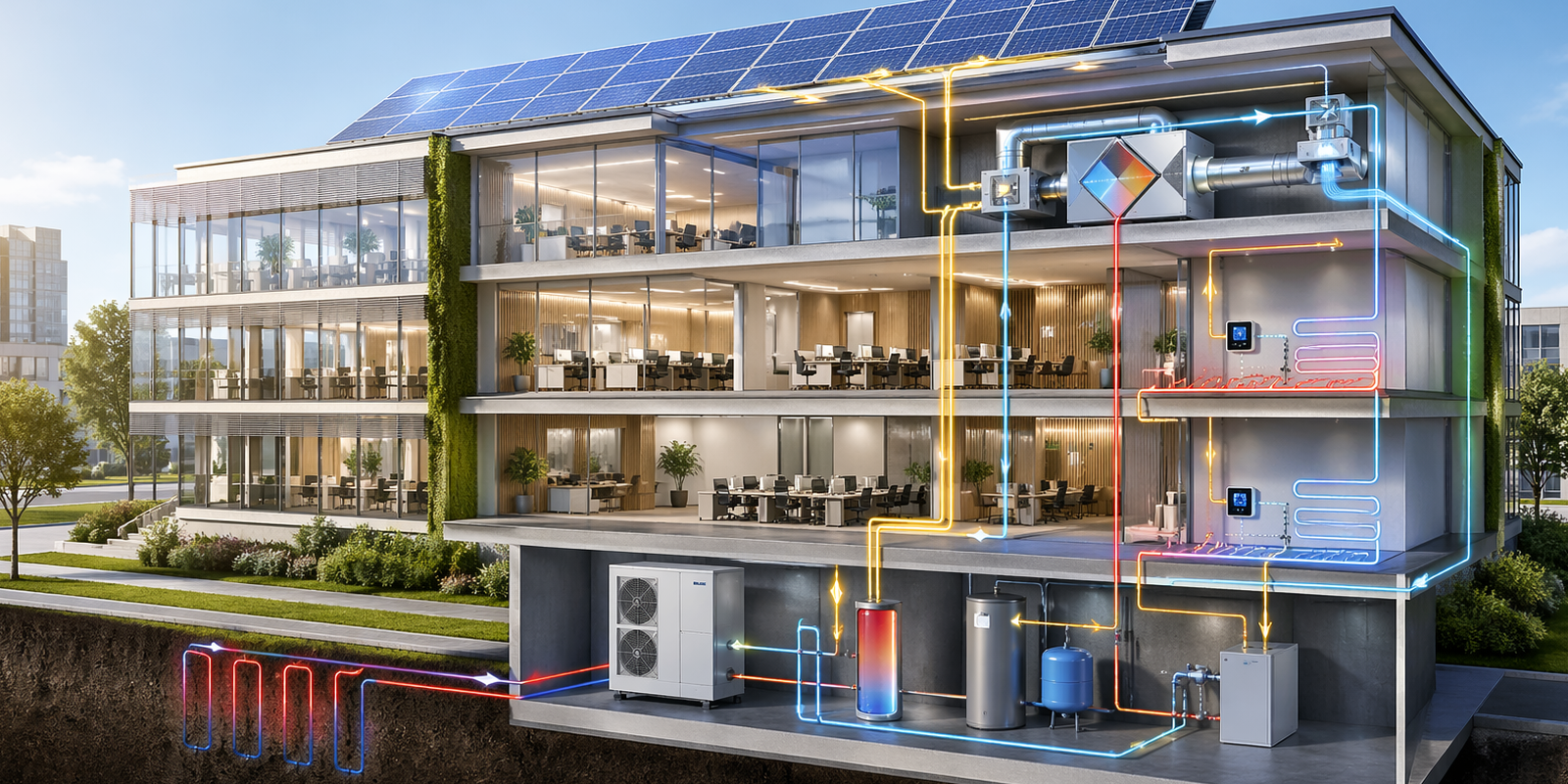
The use of renewable energy for heating, cooling, and domestic hot water reduces costs and CO₂ emissions. Waste heat recovery—from exhaust air, machinery, or process wastewater—also lowers energy costs and carbon footprint. Thermal storage decouples generation and demand over time, enabling efficient use of renewable energy and waste heat.
Description
Wind or PV electricity, ambient heat or “ambient cold” (e.g., free cooling), solar thermal energy and geothermal energy, as well as available waste heat—such as from exhaust air, wastewater, industrial processes, refrigeration systems, or IT/servers—can be used for heating, cooling, and domestic hot water supply, thereby contributing to the decarbonization of building operation. To ensure that investments in the required systems are economically viable, professional design, planning, implementation, and operational monitoring are essential. We cover the entire process from strategy development and consulting through technical development and validation to operational optimization, offering among others:
- Potential assessment (e.g., available renewable resources and waste heat sources, time-dependent heating and cooling demand)
- Feasibility studies
- Concept development (e.g., evaluation of thermal energy storage systems—hot water/cold water storage as sensible storage or ice storage as latent storage; sector coupling of electricity/heat/cooling)
- Development and evaluation of control and operation strategies (including predictive control using weather forecasts, occupancy data, and electricity price signals)
- AI-based fault detection and operational optimization (machine learning)
- Development of algorithms for energy management and load shifting Depending on the task, project scope, and objectives, various methods are applied, such as:
- Analytical estimations
- Thermal/energy simulation of buildings and systems (e.g., with TRNSYS or the VDI 6007 Part 1 building/room model)
- Numerical modeling of components and systems; digital twins
- Development of calculation models
- Application of machine learning/AI methods
- Analysis of operational data
- Measurements and monitoring
A complementary topic is the determination of realistic heating and cooling loads as well as time-dependent energy demand based on VDI guidelines 2078 and 6007 Parts 1–3. Through optimal selection and control of heating and cooling systems in combination with effective solar shading, unnecessary load peaks can be avoided and energy demand can be reduced to actual needs (e.g., maintaining thermal comfort for occupants), thereby creating optimal conditions for the use of renewable energy and waste heat.
