

Areas of application
Air filters and filter media for the removal of aerosols, dust and gases in the fields of indoor air technology, process exhaust air, vehicle cabins, combustion air, extraction equipment
Objective
We support you in evaluating and optimizing your air filter products through reliable performance assessments on our test rigs To ensure comparable results, tests are conducted in accordance with recognized international standards. In addition, we develop customized test methods for special applications or research projects.

Description
We test and characterize your filter media, filter elements, and air pollution control equipment. Depending on size, airflow, and the selected test method, we use the appropriate test rig from our technical center. We have a test rig compliant with VDI 3926 or DIN ISO 11057 for cleanable filter media, a test rig compliant with DIN 71460 or ISO 11155 for vehicle cabin filters, and a test duct compliant with EN 779 or ISO 16890 for indoor air filtration. To adapt to the measurement task, this basic test equipment can be equipped with various extensions or flexibly modified. In addition, we implement temporary, customized test setups according to customer requirements for special measurement services and research tasks.
Particle filters
Summary of filter tests of all types and classes:
- Testing of media, filter elements, or complete units
- Separation efficiency, differential pressure behavior, dust holding capacity, cleaning behavior
- Sizes: 1 cm to 6 m
- Airflow: 0.5 to 5,000 m³/h
The relevant test standards we use to test and classify filters are VDI 3926 and DIN ISO 11057, DIN 71460-1 and ISO 11155-1, EN 779, DIN EN ISO 16890, ASHRAE Standard 52.2, DIN EN 1822 and ISO 29463, ISO 5011. Typical performance characteristics of particle filters include, in addition to separation efficiency, differential pressure behavior and storage capacity. Further investigations can be conducted regarding aging behavior, cleaning, burst behavior, or leak detection. We also have experience with measurements on used filters and special filter materials such as porous foams or living plants.

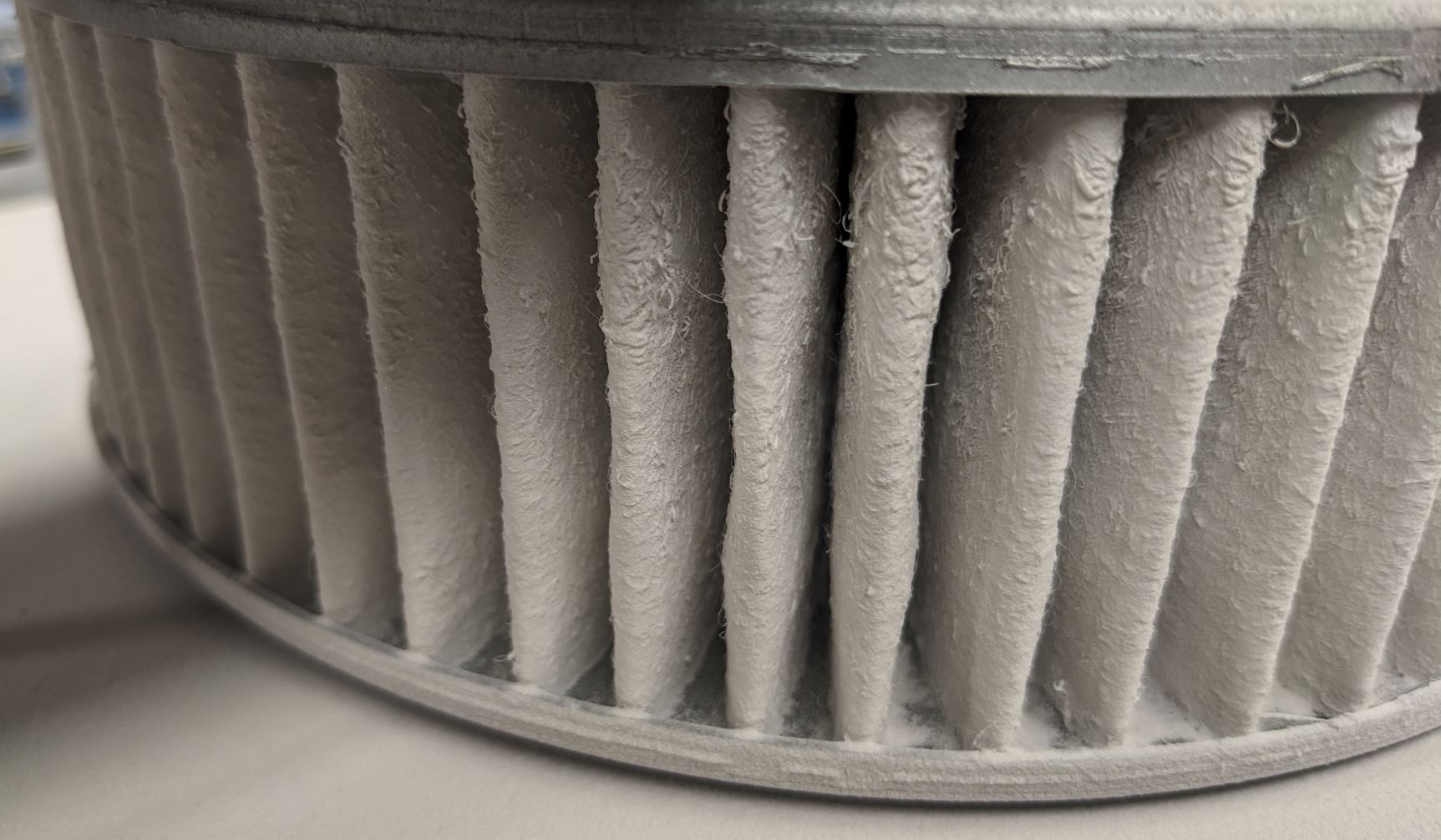

For aerosols, the fractional collection efficiency is typically determined. Depending on the size range, optical particle spectrometers, aerodynamic, or electromobility-based particle classifiers are used for this purpose. For dusts, we determine both the size-resolved efficiency and the gravimetric collection efficiency using the absolute filtration method. State-of-the-art equipment is available for the dosing of aerosols and dusts, enabling the introduction of standardized test substances (e.g., Arizona Fine Dust, Pural NF, DEHS aerosol, KCl aerosol), as well as real-world dusts from actual applications or specialized aerosols (soot, oil mist, nanoparticles from pyrolysis) and mixtures into the test air. Depending on the test substance and application, we select the most suitable measurement technology from an extensive range of equipment for particle characterization in the nano- and micrometer range.
Gas Filters
Summary of filter tests on adsorbents and gas separators:
- Test gases: hydrocarbons, SO2, H2S, NH3, NOx, others upon request
- Separation efficiency, breakthrough time, storage capacity, differential pressure
- Dimensions: up to 700 mm x 300 mm
- Volume flow: 15 to 600 m³/h
Relevant test standards in this area include DIN 71460-2, ISO 11155-2, and EN 15695-2. We can accommodate additional standards or customer-specific methods upon request.

The adsorption behavior of gas filters is primarily defined by separation efficiency and the associated breakthrough curve. The storage capacity is determined up to a defined termination criterion. During exposure to the test substance, its concentration in the raw gas and purified gas of the filter is recorded. Additionally, the desorption behavior can be characterized by subsequently shutting off the dosing.
The organic test substances typically used are toluene, isopropanol, cyclohexane, acetaldehyde, n-hexane or n-butane, which are introduced into the test air either via a micropump and evaporator or directly via a mass flow controller, depending on their physical state. Dosing devices for inorganic gases (SO2, H2S, NH3, NOx, others upon request) are also available on the test rig. The test rig´s air conditioning system allows for the setting of defined conditions for adsorption, with temperatures between 20 and 25 °C and relative humidity ranging from 50 to 80%, depending on the flow rate. For determining concentrations in the raw gas and purified gas, we have a wide range of analyzers for measuring the test substances used. These include flame ionization detectors, fluorescence spectrometers, chemiluminescence detectors, and FTIR spectrometers.
