













You are here: Home / Measurements and Tests
Development of test methods and test rigs for stationary integrated refrigeration units
How efficient is my refrigeration unit?
The objective of the R&D project was the development of a test method for stationary integrated refrigeration units. The test method comprises different device variants, like ceiling mounted, wall mounted or split refrigeration units. The method provides reliable performance data and thus enables a manufacturer-independent efficiency comparison.
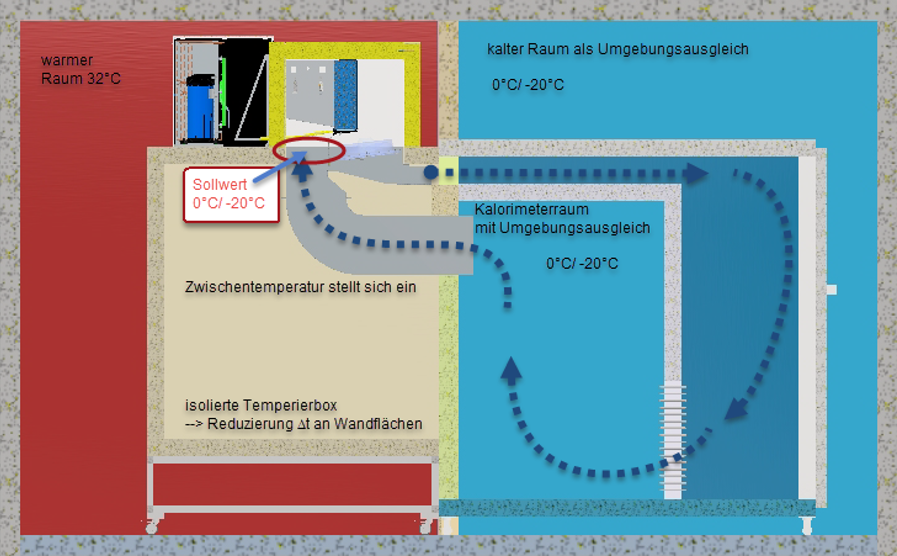
Measurements in the 3- or 4-chamber measurement setup were carried out using the calorimeter method with compensation of the ambient conditions. This enabled the measurements of devices with low cooling capacity (0.5 - 4 kW).
In the selected test setup (Figure 1), the cooling capacity is measured indirectly via an electrical power of the compensation heating. To determine the total cooling capacity, the heat input into the calorimeter room and, if necessary, internal loads (sensible and latent heat) have to be added together.
The test method comprises following features:
- Suitable for low temperature devices (-20 °C) and normal temperature cooling (0 °C)
- Measurement in the calorimeter room (3- or 4-zone concept)
- Determination of heat input via enclosure surfaces before power measurement
- Establishment of equilibrium conditions (settling phase) of the temperatures to be set (up to 24 h)
- Measuring period up to 6 h with permissible tolerance band of 0.2 K
Conclusion:
- Results were included in new test standard prEN 17432
- Establishment of a uniform Europe-wide comparison criterion
- Performance and efficiency data on a uniform basis leads to higher confidence and thus also to lower consumption costs
Your Request

Further Projects - Measurements and Tests



Tensile and compression testing
Determination of yield strength, tensile strength and elongation at break


Breakthrough Sensor for Adsorption Filters (BelA)
Sensor system for detecting an imminent breakthrough in gas filtration