






You are here: / Home
Production of novel barrier layers on polymer materials to reduce hydrogen permeation
PerWas
Project objective
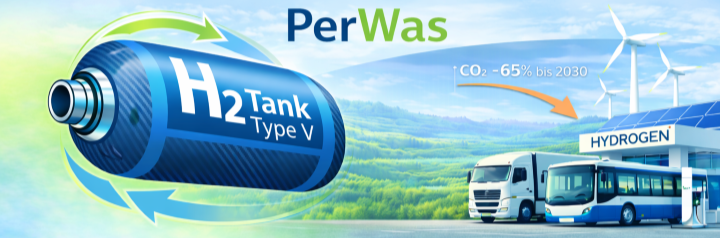
Industry, the energy sector and transportation are among the largest contributors to greenhouse gas emissions worldwide. To achieve climate targets, such as reducing CO₂ emissions in Germany by at least 65% by 2030, hydrogen is becoming increasingly important as an energy carrier and as a storage medium for renewable energy.
For hydrogen to be used economically and safely, losses due to permeation in storage systems must be minimized. The aim of the project is therefore to develop a next-generation hydrogen tank system (Type V) with a significantly improved permeation barrier. Innovative material and surface concepts are intended to substantially reduce hydrogen permeability while enabling industrial-scale implementation.
The project results will particularly strengthen small and medium-sized enterprises along the hydrogen tank value chain—from the development and processing of CFRP materials and surface modification through to suppliers for the automotive and commercial vehicle industries—and enhance their competitiveness in national and international markets.
Partners in the joint project PerWas
- Institut für Luft- und Kältetechnik gGmbH, Dresden (ILK)
- FILK Freiberg Institute gGmbH, Freiberg (FILK)
- Leibniz-Institut für Polymerforschung e.V., Dresden (IPF)

Project Advisory Committee
The joint project is technically supported by a committee consisting of testing and certification service providers, material and coating manufacturers, engineering firms, fibre-reinforced plastics and CFRP specialists, test bench and measurement technology companies, surface engineering providers, and sensor manufacturers.
Project structure
The research project is divided into three phases.
Phase 1: Preliminary investigations of flat matrix and barrier materials.
Phase 2: Development of a matrix–barrier layer system on flat tank wall components.
Phase 3: Transfer of the technology to a 3D component as a demonstrator.
Your Request
Further Projects

Tensile and compression testing
Determination of yield strength, tensile strength and elongation at break
Breakthrough Sensor for Adsorption Filters (BelA)
Sensor system for detecting an imminent breakthrough in gas filtration